Showing posts with label landscape. Show all posts

Wednesday, 14 December 2016

Those popular dead trees

If you've been following trends in landscape photography, then you would know what "Dead Vlei" means. If you're unfamiliar with the place, it's basically a very photogenic dried up lake near Sossusvlei in the Namib-Naukluft National Park in Namibia. In the midst of this dried up lake stand a bunch of dead camelthorn trees.

Despite having been to Sossusvlei in 1995, we didn't actually knew about Dead Vlei back then. So, upon our recent road-trip through Namibia, we just had to make a plan to visit this iconic spot.

The problem with visiting a place of which you can see legions of photos over the course of a year is that it has the risk of not feeling new when you step into it for the first time. That's what happened to me. The place is haunting and special, make no mistake. I just think I'd seen so many photos of it that it didn't take my breath away in real life. I guess that is one of the problems of the modern photographic explosion.

I also found it ironic that you need to travel around 300km of gravel road from any direction to get to the entrance gate, but then you have a lovely 57km stretch of asphalt to take you to within 5km of Dead Vlei and Sossusvlei...the impact of modern tourism demands I guess.

Be that as it may - the other challenge is that it's pretty hard to capture unique and "fresh" photos of this place by now. But then again, I think often us photographers get so caught up in wanting to capture a location in our own unique way that just being in the moment and enjoying the privilege of being in a splendid spot of nature can pass us by.

So here are a couple of photos I was able to grab on the one morning we spent there.
I hope you enjoy them...

Nikon D800  |  Nikkor 14-24mm f2.8 @ 14mm  |  f16  |  1/25 SS  |  ISO-200

Nikon D3s  |  Nikkor 70-200mm f2.8 VR-II @ 145mm  |  f11  |  1/400 SS  |  ISO-200

Nikon D800  |  Nikkor 14-24mm f2.8 @ 14mm  |  f16   |  ISO-200

Let me know what you think of these in the comments below.

Keep clicking!

Morkel Erasmus

Friday, 29 April 2016

The 5 billion star hotel

I'd rather sleep under this 5 billion star sky than in any 5 star establishment in the world...

Many folks who see these images want to know how they are captured.
Here is a quick run-down of the process used to capture this photo.

  1. Get to a place where there is minimal light pollution. Nearby towns and settlements exude enough light to feasibly affect your shot and the amount of stars visible.
  2. Scout around for decent compositions during daylight, bearing in mind your main compass directions and suitable compositional elements.
  3. Use a sturdy tripod.
  4. Use a wide-angle lens with a large maximum aperture (think 1.4 or 2.8).
  5. Make sure what time the moon rises and sets, and what phase it is in - this will also affect star visibility.
  6. If you want more stars - wait for there to be no moon or new moon.
  7. If you want more landscape illumination, shoot with a subtle moon at a low position in the sky.
  8. Use your torch and camera "live view" to pre-focus on a clear object at least 10 meters in front of you, or manually set your lens to the hyperfocal distance.
  9. Set your ISO to something between 1600 and 6400, depending on your camera's low light capability and your expected ambient light.
  10. Set your exposure time to somewhere between 20 and 30 seconds (anything more will start to induce "star trails" as the earth rotates around its axis.
  11. Use a strong torch to "paint" the foreground during the exposure. I find it works best to bounce the light source off your hand and use your hand to direct the light (your hand also diffuses the light and adds some warmth to colder/blue light sources).
  12. Check the resulting shot and make adjustments to composition, focus point or settings as you deem necessary.
The settings for this image?

Nikon D800
Nikkor 14-24mm f2.8 (focal length 14mm)
f2.8
20 seconds shutter release
ISO-3200

Location?
The Mountain Zebra National Park in the Karoo desert, South Africa.

Have fun experimenting!


Morkel Erasmus

Friday, 1 January 2016

My 2015 in imperfect hindsight

As is customary for many photographers of all genres during this time of year, I started glancing over my portfolio of work captured during the year in hopes of posting a "best of" collection. I have done so since 2010, and you can see my post from 2014 HERE.

Last year I took a very specific approach, only showing photos taken at a focal length of less than 100mm, to showcase my desire for including the greater environment in my photography (particularly when it comes to wildlife photography).

That being said, 2015 was a different year for me in terms of travel and photography. I had some great experiences out in the field, but not all great sightings resulted in great photography. I also took far fewer photos on the whole compared to the previous years. My total amount of photos "kept" up to this date compare more with the final result from years like 2009, 2010 and 2011 when I was more trigger-happy than I am now, but after extensive culling and weeding out of images I was not pleased with.

I think my collection below will be more reflective of specific memorable moments I enjoyed in nature, as opposed to groundbreaking new approaches to my photography and even a veritable "best of" selection. Nevertheless, I do hope you enjoy it. I want it to be an honest reflection of my year's photography, and an even more honest reflection of the memories built up. 

Every year it just dawns on me more and more that these moments in unspoilt nature are getting rarer and rarer as wild places and natural habitat wanes and falters before the onslaught of the greed of man. I can only hope that my children will still be able to enjoy the places and species I am introducing them to now long after I am gone from this planet and they have to share it with their offspring...

Without further tear-jerking musings, here we go. Photos are posted in chronological order (date taken) and not according to personal favouritism.

As usual, clicking on the photos shows them at best resolution and against a dark background!


1. Painted Dog Silhouette
I seemed to spend a lot of time in the Kruger National Park and surrounding reserves (like the Sabi Sand) this year, indeed much more than in the previous couple of years. One thing that struck me about this moment, captured in January 2015 near Pretoriuskop in the Kruger, was that I've seen very few distinct silhouettes of the African Wild Dog (Painted Dog). The size and stature of the animal and their tendency to keep to the bush and grasslands probably add to this...it's hard to get to a vantage point lower than they are at the best of times. This image was the result of a long period of waiting - as with many of my predator images - for the subjects to become active towards the end of the day.

Nikon D3s  |  Nikkor 500mm f4 VR  |  f4.0  |  1/640 SS  |  ISO-200


2. Starstruck Windmill
We spent a week over Easter with our family in East London (a city on the South African Wild Coast). We made a road trip of it, visiting the sheep farm of my friend Rob Southey in the Karoo desert on the way down. The Karoo is famous for its extreme weather and starry skies, and it didn't disappoint! A hot flask of coffee and good company made getting these shots a real treat...


Nikon D800  |  Nikkor 14-24mm f2.8  |  f2.8  |  30 seconds  |  ISO-6400

3. Nahoon on the Rocks
Our time in East London was primarily spent with family and having fun on the beach, but I did get the opportunity to link up with some old-time online friends for the first time in real life and enjoy a sunset shoot on the rocks at the beautiful Nahoon reef. The light did not peak as I expected it to, but I do have a distinct lack of seascapes in my portfolio and it was fun adding to them nonetheless.


Nikon D800  |  Nikkor 14-24mm f2.8  |  f16  |  2 seconds  |  ISO-50

4. Mare and Foal
The aforementioned road trip ended with a 3-night stay at the Mountain Zebra National Park, a real little gem in the crown of the South African National Parks portfolio. I hadn't been there since 2011, so this was a good opportunity to spend some time soaking in the scenic views and getting re-acquainted with the interesting diversity of wildlife it offers. The park is named after the endangered Cape Mountain Zebra, and has been a huge factor in the recovery of this species from the brink of extinction. Here a mother tenderly nudges her young foal as the sun sets behind the Karoo dust.


Nikon D3s  |  Nikkor 500mm f4 VR  |  f5.6  |  1/1000 SS  |  ISO-720

5. Gaze of Defeat
I posted about this specific moment in detail on my blog earlier in the year (read HERE). It just remained with me, a very poignant gaze and a privileged view on the end of a life well lived in the bush.

Nikon D3s  |  Nikkor 500mm f4 VR  |  f5.0  |  1/500 SS  |  ISO-1100

6. Stalker
I'll let this one simply speak for itself. A moment between Africa's most adaptable and stealthy predator and me...with nothing separating us.


Nikon D3s  |  Nikkor 500mm f4 VR  |  f5.6  |  1/1000 SS  |  ISO-720

7. acroBATics
In June, the Wild Eye team hosted the inaugural Wildlife Photography Seminar at Sabi Sabi in the Sabi Sand Game Reserve. Early one morning we came across an African Harrier Hawk (Gymnogene) acrobatically hunting for prey in the bark of a dead leadwood tree. It was a fascinating sighting, the bird really put on a display hanging upside down from its talons at times to break off pieces of bark. It was quite overcast but some soft light hit the clouds behind the bird for some colour in the sky. Eventually, when reviewing the images later, I realised the intended prey was a colony of bats nesting in the dead tree. In this frame there's one in its beak. Join us again next year for this inspiring event!

Nikon D3s  |  Nikkor 500mm f4 VR  |  f5.6  |  1/1000 SS  |  ISO-3600

8. Painted Pups
One of the definite highlights of my year was being able to witness how the Ngala pack of Painted Dogs (African Wild Dogs) brought their 17 new puppies out of the den for the very first time. My wife and I were spending time with the EWT researcher Grant Beverly who monitors all the movements and dynamics of this species in the greater Kruger area, and perchance we happened to be at the den at the right time to witness the special moment when the pack called the pups out and regurgitated food for them and allowed them to explore and play around for about 45 minutes before nudging them back into the old termite mound they'd chosen as a den site.

Nikon D3s  |  Nikkor 500mm f4 VR  |  f6.3  |  1/640 SS  |  ISO-1600

9. Dust and Mayhem
A photo simply cannot convey the sensory overload and general madness that is a large dusty Mara river crossing. We had quite a couple of insane crossings during the Wild Eye Great Migration photo safari that I hosted in September with my friend Andrew Beck. This particular one started after sunset at a crossing point close to our camp, so slow shutter speeds and high ISO settings were at the order of the day. After a couple of minutes the light was too bad for photography and we could put down the cameras and just soak it all in as the herd kept crossing, a leopard snuck past our vehicle to try and grab a youngster, and the smell of wildebeest adrenaline mixed with dust hung in the air. I will be hosting another trip in August 2016, so make sure you check out the details HERE if you want to experience this bucket-list safari for yourself!

Nikon D3s  |  Nikkor 70-200mm f42.8 VR-II  |  f2.8  |  1/25 SS  |  ISO-4500

10. Graceful Grazing
This scene happened in my mind's eye at least 15 minutes before the shutter tripped. I saw the giraffe ambling along to our right, noticed the iconic scenery with Balanite trees on our left, and instructed our Wild Eye East Africa guide to cut the engine of our Land Cruiser and wait. I told my guests what I thought would happen and what kinds of images I was hoping they could achieve - and it played out exactly like I planned. This is the wide open space of the Mara Triangle, folks!

Nikon D3s  |  Nikkor 70-200mm f42.8 VR-II  |  f7.1  |  1/800 SS  |  ISO-1400

There you have it, my friends.

Thanks so much for reading along. I think I have had more "wow" images in previous years, certainly, but I like that I was really able to distill this selection down to key moments - in the end the moments and memories are what matter, not how creative you got and how much you pushed the photographic envelope. 

Perhaps in 2016 I can do more of the latter. For now, I am getting ready to head back to the Kalahari, one of my favourite self-drive safari destinations. Look out for more images upon my return!

I wish you all the very best for the coming year! May God richly bless you in your coming and going, and in your life's journey with those you love most.

Morkel Erasmus

Thursday, 12 November 2015

Madikwe: May 2010 (Part 3)

Hello everyone. It was with a shock that I realised that my last blog post was written in August! So much has happened...between hosting a Wild Eye photo safari in the Maasai Mara, jetting off to Hong Kong with my wife on assignment for Nikon Asia, and then attending the Wildlife Photographer of the Year awards in London, it's safe to say things have been hectic.

I have not even had time to process many new photos - but I do know that I have also neglected to finish this trip report from way back in 2010, so here goes.

If you missed (or forgot) the previous part, you can catch up HERE.


Day 3

Our day started with an early rise and a drive out to Tlou dam to photograph the sunrise and whatever else may come across our path. I used the animal tracks in the mud as foreground interest for this image.


There was no real activity around the dam, so we set off again, and soon we had an amazing encounter, on foot, with the unicorn of the African bush...


I've spent time on foot with these amazing creatures many times since then - but you know you always remember your first time LOL.


Just as we were about to return to Nkurru Lodge to have brunch and pack up our rooms, we came across two gorgeous male lions in the south of the reserve. They were at the end of their morning patrol and just beginning to get lazy.


After roaring loudly right next to our vehicle, and sharpening their claws against a tree - the brothers disappeared into the thickets.


And so our short safari to Madikwe came to and end.

Little did I know that this first proper meeting with Gerry van der Walt would result in a great collaboration years later in Wild Eye - thanks a lot, my friend!

I haven't been able to go back yet, and maybe soon I will. The Wild Eye crew regularly host photo safaris in Madikwe, so be sure to check it out if you are interested in visiting this underestimated piece of wilderness!

Soon to come - a 2 week trip to the Kgalagadi Transfrontier Park, from June 2010. I am sooo far behind on these trip reports, but it's great fun reliving the memories as I write them up here.

Until next time!

Morkel Erasmus

Wednesday, 19 August 2015

Under the Winterthorns

If you have been following my work for a while you would know at least two things.

1. I love Mana Pools in Zimbabwe.
2. I love showing the bigger picture in my wildlife photos.

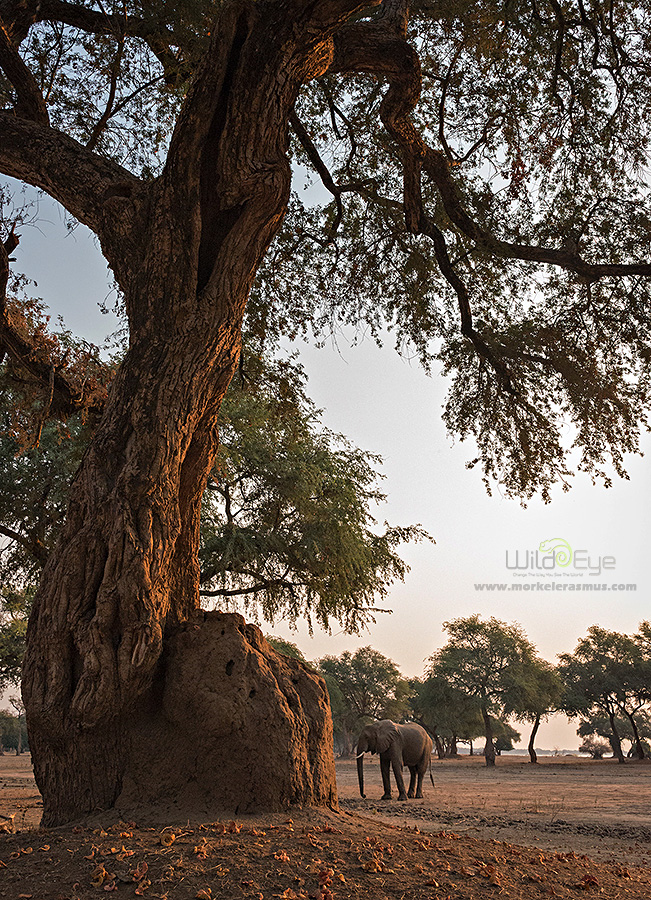
Well, I want to show you a photo taken IN Mana Pools showing the BIG picture.
It's an elephant photo, but it's not really in principle just about an elephant - got it?

First, have a look, and then I will discuss it...


Nikon D800  |  Nikkor 24-70mm f2.8  |  Circular Polariser  |  f16  |  1/160 SS  |  ISO-6400

I captured this photo alongside my guests as I hosted a Wild Eye photographic safari in conjunction with Mwinilunga Safaris in Mana Pools. 

You see, as I explained in this post, my fascination with Mana Pools goes far deeper than just the wonderful experiences that can be had walking with the elephants, lions, wild dogs etc. It's also the ethereal beauty of these floodplain-forests and the immense and gnawed Faidherbia Albida (Winterthorn) trees that dot the landscape that has me in awe.

What I was going for with this composition and perspective that actually diminishes the elephant was that encompassing sense of beauty and awe, where the elements themselves combine with the wildlife to create a sense of what I was experiencing myself in this moment as I was crouching behind the base of the tree with the termite mound around it - closer to the elephant than I was to the perceived safety of our Land Rover...

It's not primarily about the elephant. It's about the tree(s), the mood and the moment my guests and I experienced.

I'd like to think I achieved that.
I'd also like to know what YOU think...
Drop me a comment, tell me what this photo does for you!

Until next time,

Morkel Erasmus

Tuesday, 27 January 2015

Elephant in the Mara

Hello everyone. I've been a bit flooded of late so blog posts have been sparse.

In the beginning of the month, I published a collection of images from my 2014 "photographic year". Though I always do this and view it as a useful way to assess my growth and artistic voice, I purposefully posted only images taken at 100mm focal length or less. You can read the entire post HERE.

The image I am sharing today NEARLY made the cut in that post.
During our +Wild Eye photographic safari to experience the Great Migration in the Mara Triangle in September 2014, we spent some time with a gentle yet impressive African Elephant bull who was leisurely grazing on the long red oat grass along the Mara river. He was right next to our vehicle so I was able to inspire my guests to really work the scene with their wide angle lenses. I am a sucker for an "animalscape" and having a circular polariser in front of my lens helped bring out more detail in the sky and tame some of the harsh late morning light.

Techs:
Nikon D800
Nikkor 24-70mm f2.8 @ 24mm
Kenko Pro Circular Polariser
f4.0  |  1/400 SS  |  ISO-100


Do you enjoy seeing photos like this? Or do you prefer the animal to be larger in the frame?
Let me know - drop me a comment on this post and let's discuss...

Morkel Erasmus

Wednesday, 24 December 2014

Christmas in the Mountains

Good morning friends!

I just wanted to write a short post wishing you all a blessed Christmas time, wherever you find yourself in this festive season. May God abundantly bless you and bring you safely to your loved ones so you can spend valuable time together.

My family and I will be camping in the Maluti mountains (Golden Gate Highlands National Park) this weekend with my extended family, so I am looking forward to some downtime and family fun. I might just get round to capturing some landscape images like the one below which was taken at this exact location back in 2011...

See you all on the flipside - take care!


Morkel Erasmus

Monday, 15 September 2014

Floodplains of Fantasy

You've heard me rant and rave about Mana Pools a couple of times. Words fail to describe the wonder and ethereal beauty of the place...but somehow so do the majority of photos taken there. Why is that?

Is it because photos are 2D, and the Mana Pools experience is immersive, holistic and overpowers all the dimensions you perceive and the senses you use to perceive them??

Is it because you feel so insignificant in this wilderness, that you actually feel that God made it too beautiful to capture perfectly on camera, so that you feel you have to return regularly to drink the beauty and the wilderness in??

I believe that these statements above are true...

On my previous visits, I refrained from trying my hand at wide-angle landscapes, mostly because I felt part of the beauty and allure lies in the trees, and to get a real sense of the forests on the Zambezi floodplains you typically need a longer focal length to add compression to the scene. Something like this...


Nikon Df  |  Nikkor 80-400mm VR-II @ 175mm  |  f11  |  1/500 SS  |  ISO-1100

The other problem is that I actually visit this place for the wonderful wildlife encounters you can have here, as well as the total disconnect from modern life and the rat race. The best time to do this is the dry season - meaning (like in most of Southern Africa) that the skies will be cloudless most of the time. This year, I hosted a Wild Eye photo safari to Mana Pools in early September, a little later than my previous visits...for one thing there was a LOT of haze during the first 2 days due to incessant fires on both the Zimbabwean and Zambian side of the Zambezi river. Luckily, a constant wind on our 3rd day blew all the haze to someplace far away, and we had 2 more days of nice clear skies. Our final afternoon, though, was a real treat for the landscape photographer that's hidden beneath all this wildlife bravado...high clouds.

Those of you who photograph sunrises and sunsets regularly know that high clouds are often an indicator of a wonderful sunset. The problem in Mana is that the sun sets behind the mountains on the Zambian escarpment, so you have no idea whether there are clouds on the distant horizon that will block those last magical rays of red sunlight that inflame high clouds like a rampant viral outbreak.

During our last drinks stop, some of my guests wanted to photograph the lovely trees on a certain stretch of the river close to the Trichilia campsite with wide angle lenses, and I was only too happy to join them. Like it so often does, the light on the high clouds looked to pop, then fizzled...and just as I was beginning to pack up the tripod - the sunset exploded!

Now, like I said earlier, I'd never really been able to get a composition that did the trees and all the elements of the landscape justice. For me, a landscape photo taken in Mana Pools needs to convey a real sense of the place...the massive trees (and I do mean massive), the barren earth with its termite mounds sparsely spread between those trees, an elephant (okay for a wide angle landscape shot this would be a long shot), the sparkle of the broad waters of the Zambezi river, and the rising escarpment in Zambia...the ideal Mana Pools landscape photo needs to take you there, especially people who have been there. It doesn't matter if you went once as a child 80 years ago or if you fervently make a near-religious pilgrimage to Mana, once you've been there, an ideal Mana Pools photo should transport you there in an instant.

During this particular sunset, I found a couple of compositions that I feel does this. This photo is the result of manually blending 3 different exposures to get the look and feel that I was after. I wanted it to convey the detail my eye saw in the tree trunks and the distant landscape, while still capturing that magical sunset colour and light. By using the main tree as a frame for the image, I think I have conveyed something of the size of these trees: like Ents of Middle-Earth the rise up and watch over the floodplains. These trees are called Faidherbia Albida, or Winterthorn, or Ana trees...and the pods that lie on the ground are a staple food in the dry months for all the herbivores that roam these floodplains.

Here are the settings, and please do yourself a favour and CLICK on the photo so you can view it against a DARK background (this way it really comes to life), and also so you can view it at a slightly higher resolution. It's worth it...

Techs:
Nikon D800
Nikkor 14-24mm f2.8 @ 14mm
f8.0  |  ISO-200


What do you think? This spot is incidentally close to where I photographed THIS elephant 2 days prior...

I think I will probably have to return and get a better one...well, I am using that as an excuse as I really will return. Every year, I will return, as long as I am able to do so...and I will try and share the wonder of this place with as many people as I can, as long as I am able to do so.

Thank you for reading my ramblings. Have a blessed day, friends!

Morkel Erasmus

Thursday, 4 September 2014

A sense of Mana

I have just returned from hosting a Wild Eye photographic safari to a place that is cemented more and more firmly as my favourite piece of African wilderness after every visit. I thought of calling this photo "a sense of place", but it could actually only be one place, and that's Mana Pools...hence "a sense of Mana" felt more apt. 

I don't often get to use my wide-angle lenses in a wildlife context. You have to get really close to the animals, and you have to be able to shift your perspective and composition almost without barriers...and photographing from a vehicle just restricts you in those terms. Being on foot with the wildlife of Mana Pools is a totally different story, though. Many of the elephants are very relaxed around humans if you behave in the appropriate way and approach them in the right way (a qualified guide is recommended).

On this afternoon as the sun set in a hazy sky over the Zambezi river, our group was able to get close to a young male as he fed from the pods that are falling from the albida trees at this time of year. I let the landscape photographer in me dictate what I was doing here - working with the starburst of the sun peeping around the edge of the closest tree, and framing wide to provide a sense of context and place. For me, these images speak louder than full-frame portraits of your subject. I like the idea of reducing the animal from the main subject to just one of the elements in a scene that is all about the essence of the place you are visiting...where the sum of the parts is greater than the whole.

This image is a single exposure, captured while crouching to obtain a lower perspective relative to the earth and the trees, without losing the sense of the Zambezi river in the background. The elephant was quite close, but the focal length belies that in the distortion/perspective.  What do you think?

Techs:
Nikon D800
Nikkor 24-70mm f2.8 
f22 | 1/160 SS | ISO-4000


click on the image to view at optimal resolution and sharpness

I cannot more highly recommend this destination for the serious African wilderness aficionado and wildlife photographer. No other place feels quite the same after a visit to Mana! I absolutely loved seeing my guests on this past safari being infused with this same awe and love for this piece of unique wilderness.Our 2015 safaris to Mana Pools have now been extended to 5 nights, and return charter flights between Harare and Mana Pools are also included, as getting there by road from Harare just takes too much time that could rather be spent in the field (it's an all day affair if you have to be driven to Mana). Check out all the dates and details HERE...

Thanks for reading! Have a pleasant day, friends.

Morkel Erasmus

Thursday, 24 July 2014

Crumbling Walls

I really am neglecting my landscape photography - which is a shame, because I really enjoy my landscape photography! Anyhow, I was in the mood to share an older landscape photo from my archives - so I hope you like this one.

I captured this sunset a couple of years back on a local farm close to where I live. The farm belongs to family friends of ours so obtaining access is not a problem. These old farmhouse ruins provide plenty of interest on the otherwise boring scenery of the Mpumalanga Highveld.

I blended 3 separate exposures here to obtain the best representation of the dynamic range of the scene at the time.

Techs:
Canon 7D
Canon 10-22mm USM @ 12mm
f16  |  ISO-100

click on the photo to view at optimal sharpness and resolution

Thanks for indulging me!

Morkel Erasmus

Wednesday, 14 May 2014

Sunset over Gonubie

Besides the strong focus on wildlife on this blog, I enjoy landscape photography a lot, and I know I should try to get out and do more of it. 

I posted another sunset shot from the rocks around Gonubie, East London about two weeks ago. This is a view in the opposite direction a few minutes later. I'd hoped for more of the red and pink glow on the high clouds that afternoon, but this was about as good as it got.

Techs:
Nikon D800
Nikkor 14-24mm f2.8 @ 15mm
f16  |  ISO-50
Blend of 3 exposures for better representation of the dynamic range of the scene

click on the photo to display at proper size and resolution

Have a wonderful day, and thanks for stopping by!

Morkel Erasmus

Monday, 28 April 2014

Gonubie Rocks

Hey everyone! I just returned from a family holiday to the Wild Coast region of South Africa. We visited family in the quaint seaside town of Gonubie, a few kilometers outside East London in the Eastern Cape province. Due to the focus on family time and some ghastly weather for a couple of days I was only able to get round to shooting some seascapes on our last afternoon. 

Light was promising initially, but fizzled out just as it was about to peak with clouds moving over the horizon in the West. This was taken into the East over the Indian Ocean. It's comprised of a blend of 2 exposures using the grad tool in Adobe Photoshop CC (plus some further tweaks with Nik Color Efex 4).

I went for a composition where the sky and land sort-of mirror each other, and I also got the last of the promising light on the yonder cumulus clouds.

Techs:
Nikon D800
Nikkor 14-24mm f2.8 @ 14mm
f16  |  ISO-50


click on the photo to view at proper sharpness and resolution

I hope you enjoy this one. Have a lovely day, and thanks as always for stopping by!

Morkel Erasmus

Thursday, 6 March 2014

A tree on a hill

I posted a pretty grim update on a poached rhino last night on my social media outlets, so I thought I'd just post a simplistic and serene landscape photo this morning to make up for it. I haven't been out photographing landscapes properly in a long time - I blame the wildlife haha.

This is from my archives - a trip in November 2011 to be exact. What was supposed to be a relaxing fly-fishing retreat with good friends inevitably turned into a photographic mission for me as I woke up one morning to what looked like a promising sunrise. I trudged up the hill behind our little cottage, and looked for a composition before the light peaked. I found my composition, but the light didn't really "show up" as well as I anticipated. It's still a decent image and I've kept it. What do you think?

Techs:
Nikon D3s
Nikkor 14-24mm f2.8 @ 14mm
f16  |  ISO-200  |  Blend of 3 exposures using manual luminosity masks in Photoshop


click on the image to display at proper resolution and sharpness

Thanks for your time, my friends!

Morkel Erasmus

Tuesday, 11 February 2014

In Memoriam: Basie van Zyl

Nobody can look up at the magnificence of the stars in the sky and feel untouched or unmoved by them. 

Perhaps you feel very small when gazing up at them. 
Perhaps you feel very insignificant. 
Perhaps you feel that there's so much still to discover.

I look up at the heavens and I see a chorus of praise for God our Creator. I find comfort in the fact that despite the fact that the universe is vast and the stars are beyond a number that the human mind can count to, He has chosen us and loved us and rescued us from ourselves in His Son.

f3.5  |  25 seconds  |  ISO-1600

Yesterday, one of the brightest stars in South African photography circles faded out. +Basie van Zyl was an immense inspiration to countless up-and-coming and professional photographers in the nature photography community in our country. He wrote the definitive star photography guide, he was a soul of the Kalahari sand, he was a gentleman and an all round great guy. After a sudden diagnosis of a severe form of leukemia not even 2 weeks ago, Basie passed away peacefully on Monday 10 February 2014. I count myself fortunate to have known him, laughed with him and shared a meal with him. I never got round to actually taking photos alongside him, and I will regret that for sure.

Life is short and it can all be over in an instant - make sure you love the people close to your heart fully. Remember that the best things in life are not things! Please take a moment to explore the links below...

To purchase Basie's star photography ebook (you will assist his family greatly) - CLICK HERE

To get an idea of his commitment to his craft and his passion for nature, do yourself a favour and read the following blog posts detailing how he managed to obtain an amazing series of photos showing Malachite Kingfishers at their nest:
Part 1
Part 2 


Thanks for your time! Please keep his wife and son and his close family and friends in your prayers during this time of grief.


Morkel Erasmus

Monday, 9 December 2013

Classical Etosha

Hey everyone. I am just back from a round-trip family safari with my wife and two small kids. We visited Etosha National Park in Namibia, and the Kgalagadi Transfrontier Park in South Africa. Both parks are arid and unique in their own way and we enjoyed the trip very much, despite there being some quiet days when it comes to game viewing.

This photo was taken one afternoon as the storms were passing over the Etosha Pan. It's a classical composition and nothing unique, but I still like it. It shows a Gemsbok/Oryx alone on the vast Etosha Pan, with the nourishment of rain after a 2 year drought imminent.

Techs:
Nikon D800
Nikkor 70-200mm f2.8 VR-II @ 200mm
f8.0  |  1/250 SS  |  ISO-640
Exposure Bias +0.7 

click on the photo to display properly
I am looking forward to sharing more of the images from this trip as time goes by!

Morkel Erasmus

Tuesday, 19 November 2013

Death under the Stars

Few things in the African bush evoke such awe and nostalgia as standing under a moonless clear sky at night and gazing up at the starry expanse above. How many other explorers and adventurers before us have done the same at night (while shuddering involuntarily at the roar of a lion that sounds closer than it is)

This image was photographed in Etosha (Namibia) at a private research waterhole where I was privileged to spend some time earlier this year with my friend Hans Rack. Needless to say, this shoot was kind of interesting as elephants and rhinos would move ultra-silently and walk past us within a few meters (and the lions weren't too far by the sound of it). We remained within a reasonably safe radius from our sleeping structure...but it remained a bit unnerving and exciting at the same time. Gotta love these adventures!

On this flat featureless terrain there wasn't much I could use as a foreground anchor in this shot - but luckily some Kudu remains helped to give this an ominous feel. What do you think?

Techs:
Nikon D800
Nikkor 14-24mm f2.8
f2.8  |  30 seconds  |  ISO-3200


click on the photo to display properly

I am off to Etosha with my family on Friday - and though I won't be able to repeat this excursion I am looking forward to another trip to the African wilderness!

Morkel Erasmus

Wednesday, 6 November 2013

Drakensberg Serenity

It's been a while since I posted a landscape photo, so I might as well do it today. I enjoy landscape photography a lot...it's just that those darn animals take up so much of my photographic attention, okay?

This was taken earlier this year during a lovely family breakaway to the southern Drakensberg region - more precisely to the Castleburn resort close to Underberg. It's a beautiful area and I will definitely be back there someday to explore some more. This photo shows the Castleburn lake (which is a good spot for some fly fishing) after a thunderstorm had passed through one afternoon. I love the dynamic range of my Nikon D800! This photo is a SINGLE exposure, where I was able to bring up shadow detail by more than a whole stop without introducing a real semblance of noise. Normally I would have had to blend two exposures to get this kind of detail in the entire range of tones.

Techs:
Nikon D800
Nikkor 14-24mm f2.8 @ 14mm
f5.6  |  1/200 SS  |  ISO-64
Shot handheld

click on the photo to display properly
Let me know what you think of this one...

Morkel Erasmus