Showing posts with label albida. Show all posts

Wednesday, 19 August 2015

Under the Winterthorns

If you have been following my work for a while you would know at least two things.

1. I love Mana Pools in Zimbabwe.
2. I love showing the bigger picture in my wildlife photos.

Well, I want to show you a photo taken IN Mana Pools showing the BIG picture.
It's an elephant photo, but it's not really in principle just about an elephant - got it?

First, have a look, and then I will discuss it...
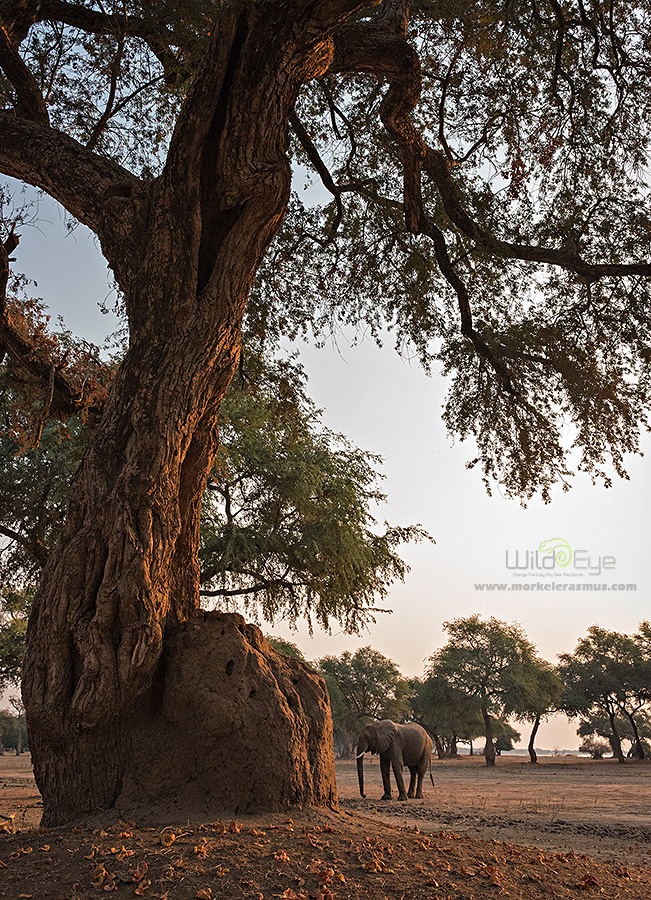

Nikon D800  |  Nikkor 24-70mm f2.8  |  Circular Polariser  |  f16  |  1/160 SS  |  ISO-6400

I captured this photo alongside my guests as I hosted a Wild Eye photographic safari in conjunction with Mwinilunga Safaris in Mana Pools. 

You see, as I explained in this post, my fascination with Mana Pools goes far deeper than just the wonderful experiences that can be had walking with the elephants, lions, wild dogs etc. It's also the ethereal beauty of these floodplain-forests and the immense and gnawed Faidherbia Albida (Winterthorn) trees that dot the landscape that has me in awe.

What I was going for with this composition and perspective that actually diminishes the elephant was that encompassing sense of beauty and awe, where the elements themselves combine with the wildlife to create a sense of what I was experiencing myself in this moment as I was crouching behind the base of the tree with the termite mound around it - closer to the elephant than I was to the perceived safety of our Land Rover...

It's not primarily about the elephant. It's about the tree(s), the mood and the moment my guests and I experienced.

I'd like to think I achieved that.
I'd also like to know what YOU think...
Drop me a comment, tell me what this photo does for you!

Until next time,

Morkel Erasmus

Monday, 15 September 2014

Floodplains of Fantasy

You've heard me rant and rave about Mana Pools a couple of times. Words fail to describe the wonder and ethereal beauty of the place...but somehow so do the majority of photos taken there. Why is that?

Is it because photos are 2D, and the Mana Pools experience is immersive, holistic and overpowers all the dimensions you perceive and the senses you use to perceive them??

Is it because you feel so insignificant in this wilderness, that you actually feel that God made it too beautiful to capture perfectly on camera, so that you feel you have to return regularly to drink the beauty and the wilderness in??

I believe that these statements above are true...

On my previous visits, I refrained from trying my hand at wide-angle landscapes, mostly because I felt part of the beauty and allure lies in the trees, and to get a real sense of the forests on the Zambezi floodplains you typically need a longer focal length to add compression to the scene. Something like this...


Nikon Df  |  Nikkor 80-400mm VR-II @ 175mm  |  f11  |  1/500 SS  |  ISO-1100

The other problem is that I actually visit this place for the wonderful wildlife encounters you can have here, as well as the total disconnect from modern life and the rat race. The best time to do this is the dry season - meaning (like in most of Southern Africa) that the skies will be cloudless most of the time. This year, I hosted a Wild Eye photo safari to Mana Pools in early September, a little later than my previous visits...for one thing there was a LOT of haze during the first 2 days due to incessant fires on both the Zimbabwean and Zambian side of the Zambezi river. Luckily, a constant wind on our 3rd day blew all the haze to someplace far away, and we had 2 more days of nice clear skies. Our final afternoon, though, was a real treat for the landscape photographer that's hidden beneath all this wildlife bravado...high clouds.

Those of you who photograph sunrises and sunsets regularly know that high clouds are often an indicator of a wonderful sunset. The problem in Mana is that the sun sets behind the mountains on the Zambian escarpment, so you have no idea whether there are clouds on the distant horizon that will block those last magical rays of red sunlight that inflame high clouds like a rampant viral outbreak.

During our last drinks stop, some of my guests wanted to photograph the lovely trees on a certain stretch of the river close to the Trichilia campsite with wide angle lenses, and I was only too happy to join them. Like it so often does, the light on the high clouds looked to pop, then fizzled...and just as I was beginning to pack up the tripod - the sunset exploded!

Now, like I said earlier, I'd never really been able to get a composition that did the trees and all the elements of the landscape justice. For me, a landscape photo taken in Mana Pools needs to convey a real sense of the place...the massive trees (and I do mean massive), the barren earth with its termite mounds sparsely spread between those trees, an elephant (okay for a wide angle landscape shot this would be a long shot), the sparkle of the broad waters of the Zambezi river, and the rising escarpment in Zambia...the ideal Mana Pools landscape photo needs to take you there, especially people who have been there. It doesn't matter if you went once as a child 80 years ago or if you fervently make a near-religious pilgrimage to Mana, once you've been there, an ideal Mana Pools photo should transport you there in an instant.

During this particular sunset, I found a couple of compositions that I feel does this. This photo is the result of manually blending 3 different exposures to get the look and feel that I was after. I wanted it to convey the detail my eye saw in the tree trunks and the distant landscape, while still capturing that magical sunset colour and light. By using the main tree as a frame for the image, I think I have conveyed something of the size of these trees: like Ents of Middle-Earth the rise up and watch over the floodplains. These trees are called Faidherbia Albida, or Winterthorn, or Ana trees...and the pods that lie on the ground are a staple food in the dry months for all the herbivores that roam these floodplains.

Here are the settings, and please do yourself a favour and CLICK on the photo so you can view it against a DARK background (this way it really comes to life), and also so you can view it at a slightly higher resolution. It's worth it...

Techs:
Nikon D800
Nikkor 14-24mm f2.8 @ 14mm
f8.0  |  ISO-200


What do you think? This spot is incidentally close to where I photographed THIS elephant 2 days prior...

I think I will probably have to return and get a better one...well, I am using that as an excuse as I really will return. Every year, I will return, as long as I am able to do so...and I will try and share the wonder of this place with as many people as I can, as long as I am able to do so.

Thank you for reading my ramblings. Have a blessed day, friends!

Morkel Erasmus

Thursday, 4 September 2014

A sense of Mana

I have just returned from hosting a Wild Eye photographic safari to a place that is cemented more and more firmly as my favourite piece of African wilderness after every visit. I thought of calling this photo "a sense of place", but it could actually only be one place, and that's Mana Pools...hence "a sense of Mana" felt more apt. 

I don't often get to use my wide-angle lenses in a wildlife context. You have to get really close to the animals, and you have to be able to shift your perspective and composition almost without barriers...and photographing from a vehicle just restricts you in those terms. Being on foot with the wildlife of Mana Pools is a totally different story, though. Many of the elephants are very relaxed around humans if you behave in the appropriate way and approach them in the right way (a qualified guide is recommended).

On this afternoon as the sun set in a hazy sky over the Zambezi river, our group was able to get close to a young male as he fed from the pods that are falling from the albida trees at this time of year. I let the landscape photographer in me dictate what I was doing here - working with the starburst of the sun peeping around the edge of the closest tree, and framing wide to provide a sense of context and place. For me, these images speak louder than full-frame portraits of your subject. I like the idea of reducing the animal from the main subject to just one of the elements in a scene that is all about the essence of the place you are visiting...where the sum of the parts is greater than the whole.

This image is a single exposure, captured while crouching to obtain a lower perspective relative to the earth and the trees, without losing the sense of the Zambezi river in the background. The elephant was quite close, but the focal length belies that in the distortion/perspective.  What do you think?

Techs:
Nikon D800
Nikkor 24-70mm f2.8 
f22 | 1/160 SS | ISO-4000


click on the image to view at optimal resolution and sharpness

I cannot more highly recommend this destination for the serious African wilderness aficionado and wildlife photographer. No other place feels quite the same after a visit to Mana! I absolutely loved seeing my guests on this past safari being infused with this same awe and love for this piece of unique wilderness.Our 2015 safaris to Mana Pools have now been extended to 5 nights, and return charter flights between Harare and Mana Pools are also included, as getting there by road from Harare just takes too much time that could rather be spent in the field (it's an all day affair if you have to be driven to Mana). Check out all the dates and details HERE...

Thanks for reading! Have a pleasant day, friends.

Morkel Erasmus