Showing posts with label Mana Pools. Show all posts

Monday, 29 August 2016

Trust your Histogram

If you've been around decent caliber wildlife photographers for any length of time, you will no doubt have heard one of them admonish someone else to always watch their histogram. It's the final litmus test for ensuring our images come out as we intend in-the-field, right?

Yes.

The important thing to remember is that you need to look at the HISTOGRAM specifically.
The actual graph plotted for the data contained in your actual image.

DON'T trust the version of the image you see on the LCD screen, though.
The back-of-camera LCD is far from a calibrated monitor on which to decide whether the colour or even apparent exposure of the image looks correct.

It's easy to fall back on pure image review and forget to rely on data interpretation. Yes, of course the content of the image is important if you are reviewing or double-checking your composition - what I am referring to is exposure checking, especially in tricky and challenging lighting conditions.

Consider this image - RAW, straight conversion, no processing applied.


If, at first glance, you thought that I had way underexposed this photo, you were correct.
Yet, I had done it on purpose!

The setting was a glorious misty sunrise on the last morning of the +Wild Eye Mana Pools photo safari I hosted in July (read the TRIP REPORT). When the sun rose behind the trees as a muted fiery ball, I knew that I wanted a photo with everything decently exposed (even the sun). So I purposely underexposed enough to protect the highlights and shadows from excessive clipping, knowing from experience what I would be able to pull back and rescue in processing. I shoot Nikon, and the specific settings might not correlate with how you would need to expose with other cameras, but I used these settings:

Nikon D800 with Nikkor 300mm f2.8 VR-II Aperture: f5.6
Shutter Speed: 1/1000
ISO: 250
Exposure bias: -2/3

In this case, I specifically remember that I couldn't really see jack squat on my LCD in terms of composition or image content, the photo was simply too dark. I needed to trust my framing in the viewfinder and also my exposure based on histogram.

The resultant histogram:


Again you might think this is creeping up too much on the shadows and highlights ends of the histogram - and yet I posit to you that this is where knowing your gear comes in and knowing how much you can recover from certain tonal areas that may seem blown out at first.

A couple of delicate processing steps later:


In processing these photos I always try and go for a look & feel that would seem natural - if you were standing there looking into a hazy sunrise you would see detail, soft light and the scene would be oozing with mood. The original frame doesn't have that at face value, and we need to tease that out of the photo in processing. Remember that the human eye can process an equivalent of about 32 f-stops in one view, so a camera can never just capture the precise way in which we perceive a moody, high dynamic range scene like this.

It's easy to overcook this as well and make it look garishly unrealistic! 

The histogram now:


The brightest spots of the sun can be blown out - it's the sun after all.
The darkest shadows are not preventing me from enjoying the image for what is ought to be - a moody dawn in the forest.

The lesson?
Know your gear well enough to shoot on instinct. 
Know well enough what you want to capture to shoot on instinct.
If necessary, read the histogram and interpret what you need to change to bring you as close as possible to a USABLE image.

I hope this post has been of help to you.

Morkel Erasmus

Wednesday, 19 August 2015

Under the Winterthorns

If you have been following my work for a while you would know at least two things.

1. I love Mana Pools in Zimbabwe.
2. I love showing the bigger picture in my wildlife photos.

Well, I want to show you a photo taken IN Mana Pools showing the BIG picture.
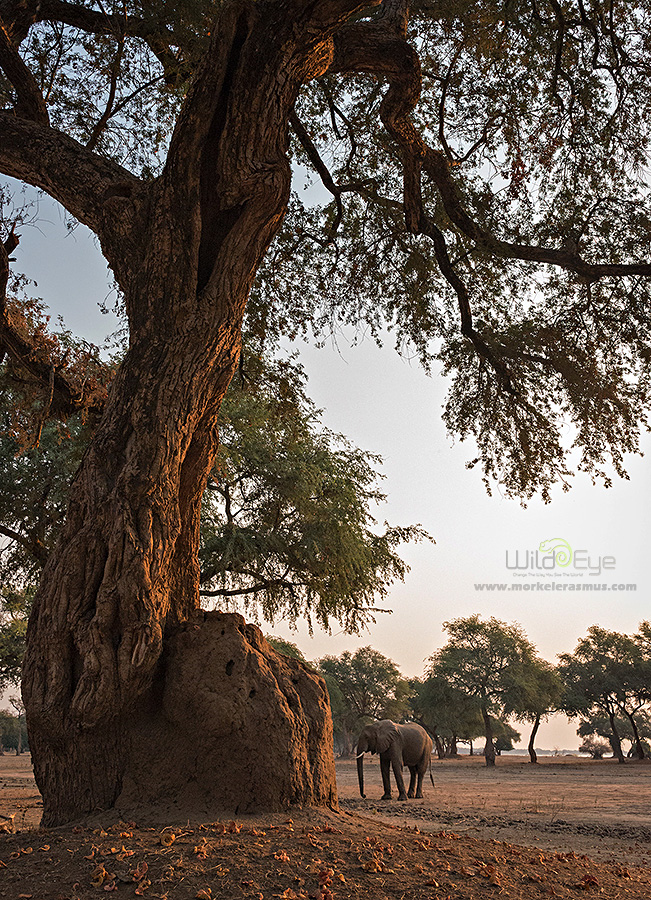
It's an elephant photo, but it's not really in principle just about an elephant - got it?

First, have a look, and then I will discuss it...


Nikon D800  |  Nikkor 24-70mm f2.8  |  Circular Polariser  |  f16  |  1/160 SS  |  ISO-6400

I captured this photo alongside my guests as I hosted a Wild Eye photographic safari in conjunction with Mwinilunga Safaris in Mana Pools. 

You see, as I explained in this post, my fascination with Mana Pools goes far deeper than just the wonderful experiences that can be had walking with the elephants, lions, wild dogs etc. It's also the ethereal beauty of these floodplain-forests and the immense and gnawed Faidherbia Albida (Winterthorn) trees that dot the landscape that has me in awe.

What I was going for with this composition and perspective that actually diminishes the elephant was that encompassing sense of beauty and awe, where the elements themselves combine with the wildlife to create a sense of what I was experiencing myself in this moment as I was crouching behind the base of the tree with the termite mound around it - closer to the elephant than I was to the perceived safety of our Land Rover...

It's not primarily about the elephant. It's about the tree(s), the mood and the moment my guests and I experienced.

I'd like to think I achieved that.
I'd also like to know what YOU think...
Drop me a comment, tell me what this photo does for you!

Until next time,

Morkel Erasmus

Monday, 15 September 2014

Floodplains of Fantasy

You've heard me rant and rave about Mana Pools a couple of times. Words fail to describe the wonder and ethereal beauty of the place...but somehow so do the majority of photos taken there. Why is that?

Is it because photos are 2D, and the Mana Pools experience is immersive, holistic and overpowers all the dimensions you perceive and the senses you use to perceive them??

Is it because you feel so insignificant in this wilderness, that you actually feel that God made it too beautiful to capture perfectly on camera, so that you feel you have to return regularly to drink the beauty and the wilderness in??

I believe that these statements above are true...

On my previous visits, I refrained from trying my hand at wide-angle landscapes, mostly because I felt part of the beauty and allure lies in the trees, and to get a real sense of the forests on the Zambezi floodplains you typically need a longer focal length to add compression to the scene. Something like this...


Nikon Df  |  Nikkor 80-400mm VR-II @ 175mm  |  f11  |  1/500 SS  |  ISO-1100

The other problem is that I actually visit this place for the wonderful wildlife encounters you can have here, as well as the total disconnect from modern life and the rat race. The best time to do this is the dry season - meaning (like in most of Southern Africa) that the skies will be cloudless most of the time. This year, I hosted a Wild Eye photo safari to Mana Pools in early September, a little later than my previous visits...for one thing there was a LOT of haze during the first 2 days due to incessant fires on both the Zimbabwean and Zambian side of the Zambezi river. Luckily, a constant wind on our 3rd day blew all the haze to someplace far away, and we had 2 more days of nice clear skies. Our final afternoon, though, was a real treat for the landscape photographer that's hidden beneath all this wildlife bravado...high clouds.

Those of you who photograph sunrises and sunsets regularly know that high clouds are often an indicator of a wonderful sunset. The problem in Mana is that the sun sets behind the mountains on the Zambian escarpment, so you have no idea whether there are clouds on the distant horizon that will block those last magical rays of red sunlight that inflame high clouds like a rampant viral outbreak.

During our last drinks stop, some of my guests wanted to photograph the lovely trees on a certain stretch of the river close to the Trichilia campsite with wide angle lenses, and I was only too happy to join them. Like it so often does, the light on the high clouds looked to pop, then fizzled...and just as I was beginning to pack up the tripod - the sunset exploded!

Now, like I said earlier, I'd never really been able to get a composition that did the trees and all the elements of the landscape justice. For me, a landscape photo taken in Mana Pools needs to convey a real sense of the place...the massive trees (and I do mean massive), the barren earth with its termite mounds sparsely spread between those trees, an elephant (okay for a wide angle landscape shot this would be a long shot), the sparkle of the broad waters of the Zambezi river, and the rising escarpment in Zambia...the ideal Mana Pools landscape photo needs to take you there, especially people who have been there. It doesn't matter if you went once as a child 80 years ago or if you fervently make a near-religious pilgrimage to Mana, once you've been there, an ideal Mana Pools photo should transport you there in an instant.

During this particular sunset, I found a couple of compositions that I feel does this. This photo is the result of manually blending 3 different exposures to get the look and feel that I was after. I wanted it to convey the detail my eye saw in the tree trunks and the distant landscape, while still capturing that magical sunset colour and light. By using the main tree as a frame for the image, I think I have conveyed something of the size of these trees: like Ents of Middle-Earth the rise up and watch over the floodplains. These trees are called Faidherbia Albida, or Winterthorn, or Ana trees...and the pods that lie on the ground are a staple food in the dry months for all the herbivores that roam these floodplains.

Here are the settings, and please do yourself a favour and CLICK on the photo so you can view it against a DARK background (this way it really comes to life), and also so you can view it at a slightly higher resolution. It's worth it...

Techs:
Nikon D800
Nikkor 14-24mm f2.8 @ 14mm
f8.0  |  ISO-200


What do you think? This spot is incidentally close to where I photographed THIS elephant 2 days prior...

I think I will probably have to return and get a better one...well, I am using that as an excuse as I really will return. Every year, I will return, as long as I am able to do so...and I will try and share the wonder of this place with as many people as I can, as long as I am able to do so.

Thank you for reading my ramblings. Have a blessed day, friends!

Morkel Erasmus

Thursday, 4 September 2014

A sense of Mana

I have just returned from hosting a Wild Eye photographic safari to a place that is cemented more and more firmly as my favourite piece of African wilderness after every visit. I thought of calling this photo "a sense of place", but it could actually only be one place, and that's Mana Pools...hence "a sense of Mana" felt more apt. 

I don't often get to use my wide-angle lenses in a wildlife context. You have to get really close to the animals, and you have to be able to shift your perspective and composition almost without barriers...and photographing from a vehicle just restricts you in those terms. Being on foot with the wildlife of Mana Pools is a totally different story, though. Many of the elephants are very relaxed around humans if you behave in the appropriate way and approach them in the right way (a qualified guide is recommended).

On this afternoon as the sun set in a hazy sky over the Zambezi river, our group was able to get close to a young male as he fed from the pods that are falling from the albida trees at this time of year. I let the landscape photographer in me dictate what I was doing here - working with the starburst of the sun peeping around the edge of the closest tree, and framing wide to provide a sense of context and place. For me, these images speak louder than full-frame portraits of your subject. I like the idea of reducing the animal from the main subject to just one of the elements in a scene that is all about the essence of the place you are visiting...where the sum of the parts is greater than the whole.

This image is a single exposure, captured while crouching to obtain a lower perspective relative to the earth and the trees, without losing the sense of the Zambezi river in the background. The elephant was quite close, but the focal length belies that in the distortion/perspective.  What do you think?

Techs:
Nikon D800
Nikkor 24-70mm f2.8 
f22 | 1/160 SS | ISO-4000


click on the image to view at optimal resolution and sharpness

I cannot more highly recommend this destination for the serious African wilderness aficionado and wildlife photographer. No other place feels quite the same after a visit to Mana! I absolutely loved seeing my guests on this past safari being infused with this same awe and love for this piece of unique wilderness.Our 2015 safaris to Mana Pools have now been extended to 5 nights, and return charter flights between Harare and Mana Pools are also included, as getting there by road from Harare just takes too much time that could rather be spent in the field (it's an all day affair if you have to be driven to Mana). Check out all the dates and details HERE...

Thanks for reading! Have a pleasant day, friends.

Morkel Erasmus

Wednesday, 27 August 2014

The Dogs of Mana Pools

On Friday morning I depart for my favourite part of Africa - Mana Pools National Park in Zimbabwe. I am hosting a Wild Eye photographic safari to this pristine and ethereal wilderness area, and I am quite excited to return there...

During our maiden voyage to Mana, my buddy Marlon du Toit and I were fortunate to spend some quality time with one of the local packs of African Wild Dogs (also called Cape Hunting Dogs or Painted Wolves). Mana Pools is a stronghold for this species, the most endangered of Africa's predators (fewer than 4000 remain in the wild).

We located the pack again on our last afternoon of the trip, sunning themselves in a dry riverbed. We decided to venture a bit closer, and to do so meant we had to physically leopard-crawl over the coarse river sand for about 40 painstaking meters, with bare elbows and knees, carrying our cameras equipped with super telephoto lenses in one hand and our beanbags in the other hand. Progress was slow, as the going was tough and we also didn't want to cause the canines distress. When we were in a good position, still not too close to cause distress, we settled in and spent some time photographing their lazy antics.

Eventually, the alpha male got a whiff of us as the wind direction shifted. He immediately came closer to investigate. It was thrilling to look through the viewfinder as he bore down on us slowly, checking us out. 

Nikon D3s  |  Nikkor 500mm f4 VR-II  |  1.4x teleconverter  |  f6.3  |  1/320 SS  |  ISO-4000

When he was too close for my lens to focus, I looked up, and looked him in the eye. 

Nikon D3s  |  Nikkor 500mm f4 VR-II  |  1.4x teleconverter  |  f6.3  |  1/320 SS  |  ISO-7200

He walked around us, taking in our scent, and after ascertaining that we were not a threat to his pack, he did the unthinkable - he flopped down a mere 15 meters from where we were still lying motionless.

It was epic. 
It was a moment that forever changed the way I see wildlife photography (well, that whole Mana Pools trip changed the way I see wildlife photography, to be honest). 

Nikon D3s  |  Nikkor 500mm f4 VR-II  |  f5.6  |  1/400 SS  |  ISO-2500

To make such a direct connection with our subject was a revelation to myself and to Marlon.
We came back and vowed to share the "Mana Magic" with others.
On Friday I am going back to do just that...and hopefully the Dogs will be obliging again!

If you want to join us on our adventures in Mana Pools in 2015, then check out the details HERE.

Thanks, as always, for reading my ramblings. I'll catch you on the flipside!

Morkel Erasmus

Wednesday, 11 June 2014

Beach Elephants

I can't believe I haven't posted this photo on my blog before - but oh well, here it is. It looks like a pristine beach with idyllic white sand, but it is in fact the riverbed of the mighty Zambezi river flowing between Zimbabwe and Zambia at this point. I was sitting on the bank of the river in Mana Pools National Park (Zimbabwe), and you can see the escarpment of the Lower Zambezi Valley in Zambia rising up across the river.

The late afternoon light, combined with the hazy skies due to winter veld fires burning on the Zambian side, gave an otherworldly blissful feel to this, and this certainly echoes what I felt on this first afternoon of my first trip to this magical piece of wilderness.

I am returning on 29 August 2014 hosting a 4-night photographic safari with Wild Eye and Mwinilunga Safaris, and I can't wait. There is still a spot or two open for those keen to experience and photograph the magic of Mana Pools - you can find all the details you need HERE.

Techs:
Nikon D7000
Nikkor 70-200mm f2.8 VR-II @ 120mm
f5.6  |  1/500 SS  |  ISO-640
Exposure Bias +0.7 

please click on the photo to view at the proper resolution and sharpness

Thanks for taking the time to have a look!

Morkel Erasmus

Thursday, 3 April 2014

A Day in Mana Pools

I mince no bones about the fact that I absolutely love Mana Pools.
It is currently (and will probably remain for a long time) my favourite safari destination in Africa.

This is an older post of mine over on the Wild Eye Photo Chat blog, describing how a potential day on safari with us in Mana Pools might go. Just looking at it again makes me yearn to be back there!

You can read the original post, with plenty of eye candy in the form of photos, HERE.
You can also find out more information about joining me in Mana Pools on a safari ini 2014 HERE.


Have a great day, friends...

Morkel Erasmus

Monday, 10 March 2014

Forest Zebras

We usually associate Zebra (specifically, the species Plains/Burchell's Zebra) with the rolling plains of the savanna, and not with forests. However, there is one place where you can see them in a forest...and that's in Mana Pools National Park in Zimbabwe.

There are many things which could have been better in this photo. That darn middle zebra with its head down is my main bugbear, and the elements of the scene could have been better arranged. What I do love, is how this transports me to being out on the Mana floodplains at first light...and there's few things that beat that!! Can you spot the hippo in the background??

I captured this photo on foot. It was also my first time using the new and improved Nikkor 80-400mm VR-II lens (and I was duly impressed).

Techs:
Nikon D3s
Nikkor 80-400mm VR-II
f5.6  |  1/200 SS  |  ISO-900

click on the photo to display at proper resolution and sharpness

I will be heading to the Chobe river on Wednesday, leading my first Wild Eye photographic safari of the year. See you on the other side!

Thursday, 13 February 2014

This part of Africa is so beautiful...

...it makes me want to come and build an open-cast copper mine here!

Not. But that's the kind of thinking that must be going on in the heads of people like the directors of Zambezi Resources Limited (an Australian mining company). They are planning to open an open-cast copper mine in the MIDDLE of the Lower Zambezi National Park in Zambia!

Here are a couple of things that are VERY interesting about this case:
  1. The Lower Zambezi National Park lies on the northern banks of the mighty Zambezi river, directly opposite the Mana Pools National Park (which is a UNESCO World Heritage Site).
  2. There was a formal, proper EIA done (Environmental Impact Assessment). This EIA strongly recommended that mining does NOT continue in this area.
  3. The minister responsible for these decisions in Zambia has recently simply overturned the EIA and the decision not to continue with the project, for no apparent reason (he cites job creation but probably received a fat incentive cheque too).
  4. Tourism is the fastest growing economic sector in Zambia, and the one with the most potential for sustainable economic contribution to the country's GDP.
  5. Did I mention that the Lower Zambezi National Park lies on the northern banks of the mighty Zambezi river, directly opposite the Mana Pools National Park (which is a UNESCO World Heritage Site)?
  6. The Lower Zambezi National Park is listed to also be given UNESCO World Heritage Site status soon. This will obviously fall flat if the mining continues.
  7. The mining company claims this will be the "cleanest, greenest copper mine ever". Have you ever seen open-cast/open-pit mining? Puhleeeze. What a load of hogwash!
  8. Any pollution to the ground or surrounding water sources will flow DIRECTLY into the Zambezi, which sustains a myriad of wildlife and human settlements for hundreds of kilometers before it reaches the Indian Ocean in Mozambique.
What can we do? Mostly make a noise, spread the word and support our Zambian conservation colleagues in any way possible - believe me they are fighting this thing tooth and nail on the ground.

Firstly - check out the "No mining in Lower Zambezi National Park" Facebook page HERE

Join up by liking the page and make sure you stay updated and share important announcements from them to your Facebook network. You can also check out their blog HERE.

Secondly - check out the petition they created on Avaaz and sign that, HERE.

Have a look at this photo I took in Mana Pools...


This lovely chap is standing in the Zambezi river (in the dry months). Do you see that escarpment behind the elephant? That's Zambia...moreover, that's the Lower Zambezi National Park...and even more precisely - it's right in that basin up there that they want to open a freaking OPEN-CAST COPPER MINE. Huh? You want to what? Go on, click on that link - tell me if you think it will be "beneficial to the wildlife" as the mining company's PR release put it...

Greed is going to be the end of Africa, especially with corrupt politicians selling out our natural heritage to make a quick buck. It's sickening.

Okay, rant over.

Please have a look at the links I shared and do your part to at least spread awareness of this issue.

Have a great day, friends!

Morkel Erasmus

Thursday, 19 September 2013

Playing with Food

By now you should realise that I am crazy about a little stretch of Africa known as Mana Pools. Not only is it a place of immense beauty and a real sense of wilderness, but the fact that you are allowed to traverse the floodplains on foot at will (and at own risk, I might add) brings a whole new dimension to your safari experience as well as the kinds of photos you can capture.

We spent some time with a trio of elephant bulls one afternoon, during which the oldest one would regularly get up on his hind legs to break off a branch from the highest albida trees around (see more of that behaviour here). The other two would then come closer and feast with him. This photo shows one of the guys snapping the branch after they'd stripped the leaves from it. On the high resolution photo you can see the bark splintering as well. Shooting with a 500mm lens meant that I had to keep enough distance between myself and the big boys to be able to compose the frames properly.

Techs:
Nikon D3s
Nikkor 500mm f4 VR-II
f5.6  |  1/800 SS  |  ISO-2800
Exposure Bias +0.3


CLICK ON THE PHOTO TO DISPLAY AT OPTIMUM RESOLUTION AND SHARPNESS

If you enjoy my posts, feel free to subscribe to the blog, and do leave a comment here...

Morkel Erasmus

Saturday, 11 May 2013

PhotoShare: Mana Dreaming

I can't believe how time has flied. It's now almost a year since I made the epic journey up to Mana Pools in Zimbabwe with Marlon du Toit. 

I am still working through some images captured there last year. Here's one I thought you would enjoy. It was taken at sunset on our first afternoon in the Zambezi riverbed. I was sitting on the river bank photographing some elephants foraging in the sandy riverbed. There are few things that compare to the light of an African hazy sunset combined with dust and an iconic animal. 

Enjoy!


Morkel Erasmus

Friday, 1 March 2013

Behind the Frame: Forest King

How often do you get to see and photograph a lion in a forest? Most people who’ve been on safari in Africa see them either on grassy plains (think Masai Mara), in arid semi-desert (think Kalahari) or in thick bushveld (think Kruger Park). This photo was taken in Mana Pools National Park, Zimbabwe. What you may not perceive from this photo is how it was made.


The full images is over 9000 pixels wide. To read the whole story about how I made this photo, and to see a higher resolution version, head on over to the Wild Eye Photo Chat Blog and read my post.

Until next time!


Morkel Erasmus

Saturday, 15 September 2012

Published in the Daily Mail Online (UK)

I was pleased yesterday to see a story being run in the Daily Mail Online (UK Newspaper) about a morning I spent (along with Marlon du Toit of course) photographing the iconic elephants of Mana Pools.

I was particularly pleased that they included a bit about the current threat of mining exploration to the area, even if it's just a mention of it. I specifically requested this be included because I would hate for these images to get exposure just for my own personal gain - this area is so special to me I want to be able to use my images to raise awareness of its fragility and the threats it faces.

You can read the article and view the accompanying images


To learn more about the issues concerning Mana Pools, a UNESCO World Heritage site, link up with the Save Mana Pools Facebook Page (www.facebook.com/SaveMana).

Thanks for reading this blog!! I appreciate every view, click and comment.

Cheers!

Morkel Erasmus

Saturday, 1 September 2012

Guest Post: Wild Eye Photo Chat Blog

Ahoy!!

I have been busy as ever, and with our 2nd child being born a couple of weeks ago, SAFFAscapes hasn't been getting the attention it deserves.

If you are anxious to read some of my musings - check out this guest post I did on the Wild Eye Photo Chat Blog about the details behind my wild dog image that won the July round of the Wild Eye Photography competition.

you can read it


and in case you still haven't seen the photo...

here it is...


Morkel Erasmus

Thursday, 9 August 2012

The Magic of Mana Pools

Wow, has it been a while since I wrote a proper blog post! I'm afraid this one will also be short-ish. I still want to do a proper write-up or trip report as it were about my recent maiden trip to the magical piece of Africa that is Mana Pools, but I thought for now let me just share some images with you that might give you an idea of why I am so enamoured with the place after this visit.

Mana Pools National Park in Zimbabwe is a recognised UNESCO World Heritage site. It's a place of amazing beauty...with ancient forests filled with Ana and Acacia trees, floodplains with huge termite mounds, iconic wildlife and of course, the Zambezi river coursing along its northern border.

The place has a primal feel to it...it really made me feel like I was walking in a piece of Africa that time had forgotten, something reminiscent of the Africa described by legends like Livingstone and Hemingway. I was awe-struck and inspired by every moment of my 4-day stay.

One big advantage for photography here is that you are allowed to leave your vehicle and explore on foot. This obviously creates the opportunity for some very unique images and angle on your photos...but this is not something to be done without the presence of someone who knows African wildlife behaviour and how to react to potentially dangerous situations. We had amazing encounters with African Elephants, African Wild Dogs, a large male Lion and many more.

Here are a few images to try and convey what I experienced...


My photographic companion on this trip was Marlon du Toit, who plies his trade as a FGASA Level 3 Guide/Ranger in the Singita group (currently at Singita Sabi Sands). Our host and guide was Will Jansen, whom I can highly recommend for his knowledge of the area, his hospitality, his personality and just about everything he did to get us there, in the right spots for the best shots, and safely back again.

Unfortunately, there are a number of severe threats to this pristine location...the most notable being the granting of mining exploration rights (in classical dubious African fashion) for heavy mineral deposits in two tributary rivers along the Park's borders. Read more here at the official Avaaz petition, and please do sign your name, as this will go some way towards creating awareness and a call to action from the various role-players. This place deserves to be protected for future generations, and it deserves to be left in this primal pristine condition!


Until next time...keep those cameras ready!

Morkel Erasmus

Friday, 22 June 2012

PhotoShare: Mana Pools Elephantscape

I am recently back from a new FAVOURITE destination for Wildlife Photography - Mana Pools National Park in Zimbabwe. I am going to do a proper write-up and blog post about it in the near future, so here's just a quick PhotoShare to get you salivating. The main attraction to this place is the fact that there are huge stretches of ancient Ana and Acacia tree forests with massive trees that dwarf the elephants that roam them. Oh, and being allowed to get out of your vehicle and photograph on foot at any time also helps!

Check out this image - and I'll be back soon with more!!


(Nikon D3s, Nikkor 500mm f4 VR-II)  f4.0  |  1/800 SS  |  ISO-280


Morkel Erasmus