Showing posts with label environment. Show all posts

Wednesday, 19 August 2015

Under the Winterthorns

If you have been following my work for a while you would know at least two things.

1. I love Mana Pools in Zimbabwe.
2. I love showing the bigger picture in my wildlife photos.

Well, I want to show you a photo taken IN Mana Pools showing the BIG picture.
It's an elephant photo, but it's not really in principle just about an elephant - got it?

First, have a look, and then I will discuss it...
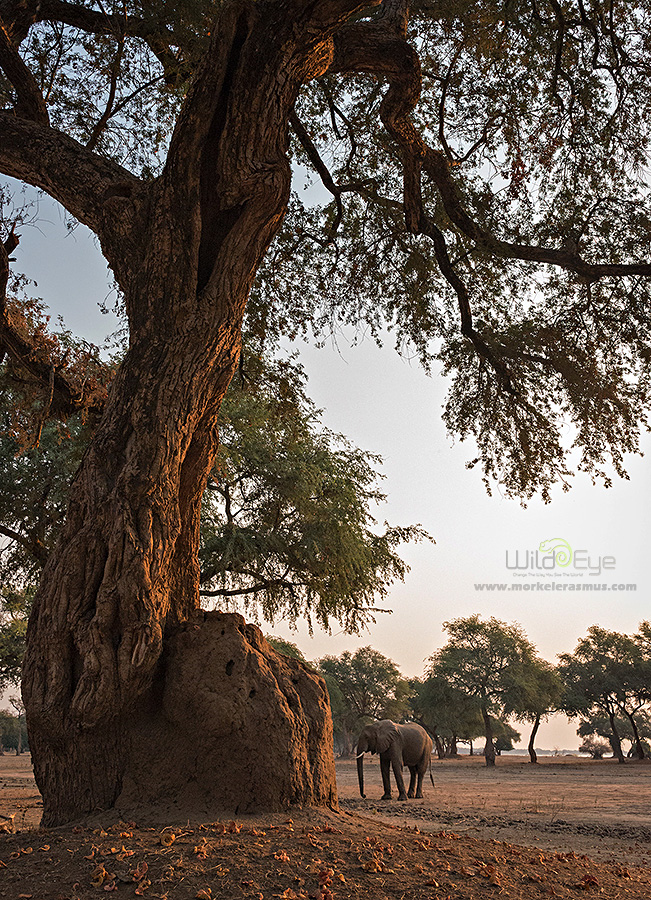

Nikon D800  |  Nikkor 24-70mm f2.8  |  Circular Polariser  |  f16  |  1/160 SS  |  ISO-6400

I captured this photo alongside my guests as I hosted a Wild Eye photographic safari in conjunction with Mwinilunga Safaris in Mana Pools. 

You see, as I explained in this post, my fascination with Mana Pools goes far deeper than just the wonderful experiences that can be had walking with the elephants, lions, wild dogs etc. It's also the ethereal beauty of these floodplain-forests and the immense and gnawed Faidherbia Albida (Winterthorn) trees that dot the landscape that has me in awe.

What I was going for with this composition and perspective that actually diminishes the elephant was that encompassing sense of beauty and awe, where the elements themselves combine with the wildlife to create a sense of what I was experiencing myself in this moment as I was crouching behind the base of the tree with the termite mound around it - closer to the elephant than I was to the perceived safety of our Land Rover...

It's not primarily about the elephant. It's about the tree(s), the mood and the moment my guests and I experienced.

I'd like to think I achieved that.
I'd also like to know what YOU think...
Drop me a comment, tell me what this photo does for you!

Until next time,

Morkel Erasmus

Sunday, 2 March 2014

CheetahScape

I've often recommended to wildlife photographers (on safaris I guide or online) that they should shoot wider to include more of the scenery, rather than merely trying to get as close as possible for as much detail as possible. One of the reasons I say this is that a very tight headshot could actually be taken anywhere (like in a zoo). Framing wider tells your audience a bit about WHERE the animal or bird found itself and WHAT it was doing. This does not always mean you should whip out a shorter/wider lens...sometimes it just means using your telephoto lens and not driving right up to your subject. 

I'm a big fan of using the compression factor that comes with the super telephoto lenses to tell stories and enhance the overall composition by seeming to bring the compositional elements closer together than they really are. The photo below shows such an example. This male cheetah was photographed in the Kgalagadi Transfrontier Park (Kalahari desert), and was scanning the Nossob riverbed for a potential breakfast target. The sun was just coming up and the light was sublime. I particularly liked how it was lighting up the shrubs and grasses around him, and a the camelthorn acacias in the distance. I chose to frame vertically (portrait orientation) to include the tree.

Techs:
Nikon D3s
Nikkor 500mm f4 VR-II
1.4x teleconverter
f5.6  |  1/640 SS  |  ISO-1600
Exposure Bias: -0.7 


I hope you found this useful, and of course I hope you like the photo. Either way, drop me a comment and let me know what you think...

Cheers!

Morkel Erasmus