Showing posts with label endangered. Show all posts

Saturday, 28 May 2016

Delight at the Dog Den

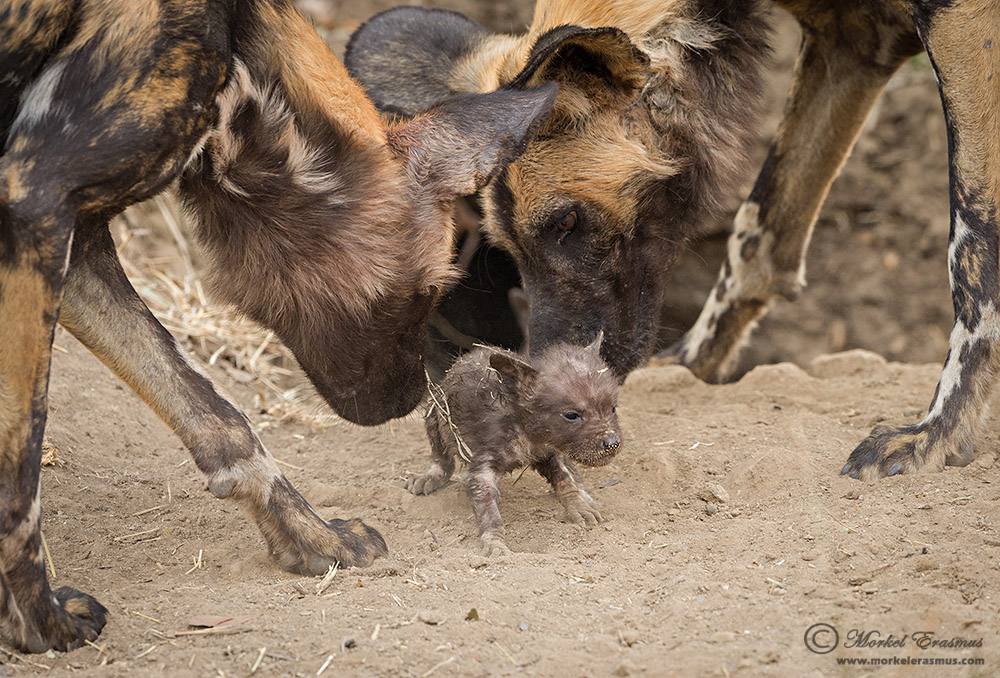
Last year, my wife and I had an incredible privilege: we witnessed the moment a massive litter of 17 highly endangered African Wild Dog (Painted Dog) puppies came out of their den for the very first time.

We were in the Lowveld on a family holiday, and got the chance to head out with Grant Beverley for the day. Grant heads up the EWT (Endangered Wildlife Trust) Wild Dog research and monitoring for the Greater Kruger area of South Africa. We visited two separate packs of the enigmatic "painted wolf". The first one was situated in the Zandspruit Aero Estate, in the town of Hoedspruit. To see these animals adapting and denning with puppies in a residential eco-estate where people were developing holiday homes was quite something!

We only caught fleeting glimpses of the alpha female of this pack, and decided to head out to the Ngala Private Game Reserve bordering the Orpen gate of the Kruger National Park.

Last year, the alpha female of this pack gave birth to a whopping 17 puppies! They had, at that point, never ventured out of the den. Grant was hoping that the pack would possibly call them out for the first time (he visited this den nearly every day, was in contact with the Ngala guides, and had camera traps installed at all his monitored den sites).

(note: all images shot in this post were captured with a Nikon D3s and Nikkor 500mm f4 VR lens)


When we arrived, the pack adults were lazing about, and I was able to capture some portraits of them. It was evident that they had recently made a kill, as their faces were covered in fresh blood.


It looked like we were in for a long wait that would possibly not result in any visual of the pups. Suddenly, one of the adults moved towards the den (seemingly an abandoned warthog burrow).


More of the adults moved towards the den entrance, with some starting to vocalise with yelps and chirps...and then two little faces appeared from the abyss!


Followed by a couple more!


What followed was just one of the most special moments I've ever witnessed in the bush - the pack proceeded to regurgitate some of their meat of the day's kill for the youngsters. It might seem gross to some people, but this is a piece of behaviour few people have had the privilege to witness as intimately as we were doing at that moment...


Here's a short video clip of what we saw!


We also sat and watched as the pups explored around their den for the first time, how some of the adults haphazardly handled the roughed up the runts of the litter, and how they all eventually were signaled by the alpha female that it was time to get back to the safety of the den.


I hope that you are not bored by now with these images!

Before it was all over, I did get a chance to capture the pups all lined up at the den entrance for one last glance at the weird people in the Land Rover with the pointy thing that keeps clicking...


It is very rare for a single female to have this many puppies. They survived much longer than anyone could have dreamed, as the pack cared well for them and protected them. In the meantime, the pack has split and regrouped with other dogs many times, so it's hard to determine exactly how many of the 17 pups have seen their first "birthday".

The work that Grant and the EWT are doing is immensely important in ensuring the viability and genetic diversity of the South African population of this rare predator. Their territories are vast, and as human encroachment keeps fragmenting the amount of land under dedicated conservation, the pressure on them will mount. Your donations can keep this team focused on monitoring and managing the greater Kruger meta-population with long-term survival and sustainability in mind. Please consider making a donation!

Thank you for viewing and reading!

Morkel Erasmus

Friday, 27 February 2015

Emergence

The sun has just set after another blissful day in this piece of remote wilderness.

In front of me is a life-giving waterhole in a harsh land, where a myriad of animals came to quench their thirst during the heat of the day...

One animal was still thirsty, though, and for some reason he had waited until everyone was gone and he could have the waterhole to himself.

I first notice him emerging from the treeline behind me...a phantom in the dusk light.
He takes note of the human presence in his path, and swerves slightly to make his way around my position towards the water. He is an experienced old warrior, the signs of many battles etched on his face and in his ears.

He sports a defense weapon that is in high demand by certain misinformed members of my species - and that makes him a constant target. Does he know this?? I doubt it. At least in this remote corner of Africa, he is safe at this particular moment as I am watching him approach, watching him emerge from the shadows...

As he scuffles towards the water, dust kicked up lingers, and all the way he seems to be "emerging" from the dust and the fading light, like a ghostly apparition. He moves very quietly for an animal of his bulk and stature...

The light is gone. I can barely make out his shape. I dial in a very slow shutter speed to limit my ISO to within the 4000-6400 band, which I know my camera can handle with aplomb.

Nikon D3s  |  Nikkor 500mm f4 VR-II  |  f4.0  |  1/60 SS  |  ISO-4500

I grab a few photos, being careful to pan lightly with him as he moves (given my slow shutter speed). Then I put the camera down and enjoy the moment. So many wildlife photographers these days forget to merely enjoy the moment, being so caught up in grabbing that "winning photo". 

We need to admire once again what drove us to take cameras on safari in the first place...
We need to maintain our respect for the natural world, instead of pushing too deeply into the natural rhythms and disturbing out subjects for "the shot"...
We need to view our subjects like we first viewed them, through the eyes of awestruck children...

We need to emerge as a driving force in raising awareness for the wildlife we love photographing, and to do that, we need to let go of our narcissism and egos...

Morkel Erasmus


Wednesday, 27 August 2014

The Dogs of Mana Pools

On Friday morning I depart for my favourite part of Africa - Mana Pools National Park in Zimbabwe. I am hosting a Wild Eye photographic safari to this pristine and ethereal wilderness area, and I am quite excited to return there...

During our maiden voyage to Mana, my buddy Marlon du Toit and I were fortunate to spend some quality time with one of the local packs of African Wild Dogs (also called Cape Hunting Dogs or Painted Wolves). Mana Pools is a stronghold for this species, the most endangered of Africa's predators (fewer than 4000 remain in the wild).

We located the pack again on our last afternoon of the trip, sunning themselves in a dry riverbed. We decided to venture a bit closer, and to do so meant we had to physically leopard-crawl over the coarse river sand for about 40 painstaking meters, with bare elbows and knees, carrying our cameras equipped with super telephoto lenses in one hand and our beanbags in the other hand. Progress was slow, as the going was tough and we also didn't want to cause the canines distress. When we were in a good position, still not too close to cause distress, we settled in and spent some time photographing their lazy antics.

Eventually, the alpha male got a whiff of us as the wind direction shifted. He immediately came closer to investigate. It was thrilling to look through the viewfinder as he bore down on us slowly, checking us out. 

Nikon D3s  |  Nikkor 500mm f4 VR-II  |  1.4x teleconverter  |  f6.3  |  1/320 SS  |  ISO-4000

When he was too close for my lens to focus, I looked up, and looked him in the eye. 

Nikon D3s  |  Nikkor 500mm f4 VR-II  |  1.4x teleconverter  |  f6.3  |  1/320 SS  |  ISO-7200

He walked around us, taking in our scent, and after ascertaining that we were not a threat to his pack, he did the unthinkable - he flopped down a mere 15 meters from where we were still lying motionless.

It was epic. 
It was a moment that forever changed the way I see wildlife photography (well, that whole Mana Pools trip changed the way I see wildlife photography, to be honest). 

Nikon D3s  |  Nikkor 500mm f4 VR-II  |  f5.6  |  1/400 SS  |  ISO-2500

To make such a direct connection with our subject was a revelation to myself and to Marlon.
We came back and vowed to share the "Mana Magic" with others.
On Friday I am going back to do just that...and hopefully the Dogs will be obliging again!

If you want to join us on our adventures in Mana Pools in 2015, then check out the details HERE.

Thanks, as always, for reading my ramblings. I'll catch you on the flipside!

Morkel Erasmus

Wednesday, 18 June 2014

Zimanga Wolfpack

Sticking with my recent trip to Zimanga Private Game Reserve...

The majority of photos coming from people who were fortunate to visit Zimanga leading up to their official opening in July 2014 have shown the fabulous photos obtainable from the bird hides currently in operation on the reserve. If you follow the reserve's Facebook Page, though, you would have seen that there's more to Zimanga than just birds. Charl Senekal has built up a gem of a reserve over the years where there's a wonderful immersive bush experience to be had. For me - a wildlife nut who enjoys to photograph birds now and again - being on foot with the resident Cheetahs and local pack of African Wild Dogs was an even better prospect.

I captured this photo one morning after we were relentlessly tracking the pack of "Painted Wolves" as they were hunting in the thickets and valleys of the reserve. These animals are the most endangered of Africa's predators. We eventually caught up with them as they finished a small kill. We approached them on foot, and as they came out onto the road I was able to lie flat down on my side and capture an image that framed them with the natural dense foliage of the area they were in, complemented by the morning light filtering through the tree canopy as well as the very low angle I was able to achieve. I can't wait to get back there and spend more time with this pack of impressive canines!

I left the collar on the one on the left...easy to clone out though if that's your thing. This pack is monitored by the reserve management and the Wildlife ACT volunteers - adults from this pack have been used to successfully repopulate various reserves across South Africa at no cost, also adding valuable genetic variation to regions with limited genetic variation - a good beacon of hope for Africa's most endangered predator. I have tremendous respect and appreciation for the way in which Charl is managing his wild dogs and using them to aid in bolstering the genetic pool of Wild Dogs in other reserves in South Africa.

Techs:
Nikon D3s
Nikkor 500mm f4 VR-II
f4.0  |  1/640 SS  |  ISO-400

click on the photo to display at optimal resolution and sharpness

Thanks for your time! I hope you enjoyed this image.

Morkel Erasmus

Thursday, 8 May 2014

Dusk Zebra

I absolutely love photographing wildlife in the soft light just before sunrise or after sunset. There's a luminous soft glow and saturating mood that you just don't get in any other kind of natural light. I literally don't care what my subject is when I'm in this precious short window of light...

This particular photo was taken in the Mountain Zebra National Park of South Africa, a small reserve which has immensely beautiful vistas all around and is a highly underrated safari destination. Situated in the Karoo semi-desert near the town of Cradock, this National Park now sports lions and cheetahs, along with several interesting herbivore species and it's also a hotspot for seeing the elusive Aardwolf! 

This photo shows the endangered Cape Mountain Zebra (from whom the park takes its name). This species was critically endangered in the early 1900's but was brought back to a sustainable population thanks to the efforts of the South African National Parks, with the establishment of this particular National Park in 1937 no small step in securing their future.

You can read more about the park HERE.

Techs:
Canon 7D
Canon 300mm f2.8 L IS USM
f2.8  |  1/100 SS  |  ISO-1600


Enjoy your day, friends!

Morkel Erasmus

Sunday, 22 September 2013

World Rhino Day 2013

As is customary, I like to do a short post on 22 September, which has been World Rhino Day for the last few years. As this post goes live, I am on my way to the Masai Mara for a Wild Eye Great Migration photographic safari which I am hosting with Marlon du Toit.

Here's a photo of a Black Rhino I photographed in an undisclosed location. This particular youngster was very agitated and charged everything in sight, even the poor Plover flying in front of him.

click on the photo to display at optimal resolution and sharpness

The various rhino species in the world are under immense pressure due to an increase in wealth in Eastern nations like Thailand, Vietnam and China where the horn is used in traditional medicine and ornaments. The horn has absolutely NO medicinal value or properties!

To find out more about the World Rhino Day initiative, check out their website:
www.worldrhinoday.org

More information on rhino conservation and anti-poaching initiatives:
www.stoprhinopoaching.com
www.savetherhino.org

The latest poaching stats in South Africa, from SANParks:

We can only hope and pray that this magnificent species can one day be seen in the wild by our children and their children. If you know people who are consumers of rhino horn, please try and spread awareness of these issues to them. I doubt many of them know HOW the horn is harvested, and that it's useless for their health.

Thursday, 14 July 2011

Petition: Stop Rhino poaching in Africa!

Hi there folks.

This'll be a short post. I was shared this petition by a fellow photographer on Facebook and thought to send it on via my blog too. Many of you might be aware of this issue already, but Rhino poaching has been on a dramatic increase over the last 2 years, especially in my native South Africa.

By June the 3rd 2011, more than 170 rhinos had already been wiped out for their horns, and in the 2010 calendar year the figure amounted to more than 1 per day on average. The ridiculous notion held in the Far East that their horns are worth something medicinally and helpful for sexual arousal is fueling the demand for this "commodity".

Please take a moment to sign this petition HERE, which is due to be sent to high-ranking government officials in Vietnam.


Thanks for your time!


Yours in conservation (in a very small way),
Morkel Erasmus

Wednesday, 19 May 2010

A dark future??

This blog post has been coming for a while now, since finding out more of the shocking statistics about the increase in Rhino poaching in South Africa and Africa in general of late, and since reading an article by world-famous widllife filmmakers/photographers/conservationists Dereck and Beverly Joubert about how lions, once thought the least endangered predator in Africa, are now facing extinction in the long run.

Recent blog posts by Shem Compion and Gerry van der Walt (click on their names to go and read their posts) have also served as catalysts for my thoughts in this blog post.

For me, the privilege of being able to capture forever moments of natural history in the wild places of Africa really boils down to leaving a legacy...something tangible that might still be able to be enjoyed long after all that we've seen and all that we've come to love in Africa (and other wonderful locations around the world) has passed away and been replaced by garbage dumps and concrete living quarters. Now, don't get me wrong, I'm not one of those "tree-huggers" who will chain themselves to whaling ships or despise all technological advancement (although I do think whaling is disgusting and that some technology cripples us more than it enables us to better conserve our planet)...in fact I do drive an SUV (maybe not as big a gas-guzzler as a Hummvee but one that at least gets me where I need to be in Africa, potholes in the roads being more dangerous than the wildlife these days), and I do live in a bustling town of industry and I do in fact work in a field that creates a bit of pollution. But one thing I know...I love Africa. I love her vibe, her cadence, her charisma, her unbridled energy and most of all, her natural beauty.

I find myself longing for days long gone when explorers such as Livingstone and Hemingway stood atop the kopjes of the African plains, and looking out in all directions all they saw was a mass of animal life as far as the eye could see. Large herds of elephants with tusks thrice as long as a man...buffalo herds that made the great wildebeest migration look like a flea circus...clans of wild dog that roamed vast grasslands and outnumbered even large predators like lions. These men could only but capture their fascination with Africa in their writing, and boy do these tales excite...grand sweeping prose that makes you yearn for times gone by with a thick lump in your throat. These days we have the tools to make those memoirs even more vivid...our cameras. The majesty and elegance and beauty of this continent of ours is now in our hands to portray to all who would perhaps stop by our blogs, read our books or stumble upon our images on a calendar or in a magazine, and if I can evoke those same feelings in at least one other person, I would be ecstatic.

The fact that poaching of rhinos (for the supposed medicinal value of their horns) is rising at an alarming rate all over Africa, and more specifically in the national parks and wildlife reserves of South Africa, has sparked these ideas into another direction. What if the only rhino/cheetah/leopard (fill in the blanks) that my children will ever get to see, are the ones that I have had the privilege of taking photos of during my lifetime??? What if I can never take them to the places I've been and show them the things I've seen, save for showing them a large print of a photo that tries in some meager way to capture the essence of the animal/bird?

This rhino bull was captured in stunning morning sidelight, and I deliberately underexposed with a moody black-and-white photo in mind to convey my concern over this species and others. I hope with all my heart to show this one to my own children one day, and then get into the car, drive to a nearby reserve and show them the real thing...


As Gerry rightly put - we need to take action on a grander scale than merely joining a Facebook group or signing up for a newsletter at Conservation organisation. How and what that involvement will be is up to each of us to determine, decide, and put into action. Until I have the funds to invest in conservation efforts and sponsor large-scale projects, I will continue to try and share the images I have the honour of taking with whoever wants to see. And I do hope we all desire very much to SEE...

Morkel Erasmus