Showing posts with label Kruger National Park. Show all posts

Saturday, 28 May 2016

Delight at the Dog Den

Last year, my wife and I had an incredible privilege: we witnessed the moment a massive litter of 17 highly endangered African Wild Dog (Painted Dog) puppies came out of their den for the very first time.

We were in the Lowveld on a family holiday, and got the chance to head out with Grant Beverley for the day. Grant heads up the EWT (Endangered Wildlife Trust) Wild Dog research and monitoring for the Greater Kruger area of South Africa. We visited two separate packs of the enigmatic "painted wolf". The first one was situated in the Zandspruit Aero Estate, in the town of Hoedspruit. To see these animals adapting and denning with puppies in a residential eco-estate where people were developing holiday homes was quite something!

We only caught fleeting glimpses of the alpha female of this pack, and decided to head out to the Ngala Private Game Reserve bordering the Orpen gate of the Kruger National Park.

Last year, the alpha female of this pack gave birth to a whopping 17 puppies! They had, at that point, never ventured out of the den. Grant was hoping that the pack would possibly call them out for the first time (he visited this den nearly every day, was in contact with the Ngala guides, and had camera traps installed at all his monitored den sites).

(note: all images shot in this post were captured with a Nikon D3s and Nikkor 500mm f4 VR lens)


When we arrived, the pack adults were lazing about, and I was able to capture some portraits of them. It was evident that they had recently made a kill, as their faces were covered in fresh blood.


It looked like we were in for a long wait that would possibly not result in any visual of the pups. Suddenly, one of the adults moved towards the den (seemingly an abandoned warthog burrow).


More of the adults moved towards the den entrance, with some starting to vocalise with yelps and chirps...and then two little faces appeared from the abyss!


Followed by a couple more!


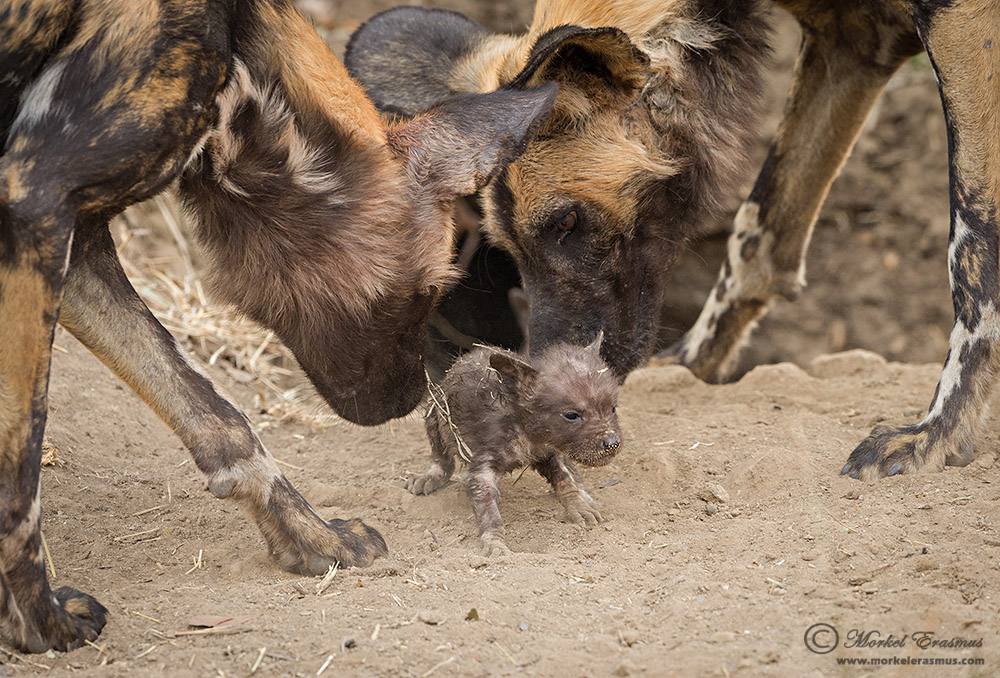
What followed was just one of the most special moments I've ever witnessed in the bush - the pack proceeded to regurgitate some of their meat of the day's kill for the youngsters. It might seem gross to some people, but this is a piece of behaviour few people have had the privilege to witness as intimately as we were doing at that moment...


Here's a short video clip of what we saw!


We also sat and watched as the pups explored around their den for the first time, how some of the adults haphazardly handled the roughed up the runts of the litter, and how they all eventually were signaled by the alpha female that it was time to get back to the safety of the den.


I hope that you are not bored by now with these images!

Before it was all over, I did get a chance to capture the pups all lined up at the den entrance for one last glance at the weird people in the Land Rover with the pointy thing that keeps clicking...


It is very rare for a single female to have this many puppies. They survived much longer than anyone could have dreamed, as the pack cared well for them and protected them. In the meantime, the pack has split and regrouped with other dogs many times, so it's hard to determine exactly how many of the 17 pups have seen their first "birthday".

The work that Grant and the EWT are doing is immensely important in ensuring the viability and genetic diversity of the South African population of this rare predator. Their territories are vast, and as human encroachment keeps fragmenting the amount of land under dedicated conservation, the pressure on them will mount. Your donations can keep this team focused on monitoring and managing the greater Kruger meta-population with long-term survival and sustainability in mind. Please consider making a donation!

Thank you for viewing and reading!

Morkel Erasmus

Tuesday, 16 February 2016

Lion Man Love

It was a crisp winter's morning.
Francolins were calling, announcing the unavoidable dawn that was breaking.
The Land Rover engine was chugging along as we slowly crawled out of the lodge grounds of Leopard Hills Private Game Reserve in the Sabi Sand (South Africa).

Then the roaring of lions brought us on high alert.
We followed, and came across one of the legendary Majingilane coalition male lions, walking up the road ahead of us and roaring towards his brothers. His brothers answered!

Nikon D3s  |  Nikkor 500mm f4 VR-II  |  f4.0  |  1/200 SS  |  ISO-3200

Soon we were witness to a reunion of these males - they had all been patrolling various corners of their territory, and this morning was their bonding moment. It was gloomy weather, but as I always do I just push up the ISO and let my trusty Nikon capture the action.

Nikon D3s  |  Nikkor 500mm f4 VR-II  |  f4.0  |  1/200 SS  |  ISO-6400

A third male joined, and they started rolling over each other, rubbing their scent off on one another and just bonding like lion brothers often do.

Nikon D3s  |  Nikkor 500mm f4 VR-II  |  f5.0  |  1/250 SS  |  ISO-5000
Nikon D3s  |  Nikkor 500mm f4 VR-II  |  f5.0  |  1/250 SS  |  ISO-3200


And then...things got awkward. Very awkward! :)


Nikon D3s  |  Nikkor 500mm f4 VR-II  |  f5.0  |  1/250 SS  |  ISO-4000

And no, this is not proof that animals have same-sex tendencies (before anyone jumps on a bandwagon that this post is not intended to provide)...this is purely a display of dominance and is not all that uncommon in mammals. It's a gesture, no real action is taken by the instigator, and the purpose is to assert dominance in a setting such as this where there are multiple males in a coalition and some sort of hierarchy is ascribed to. It was over in a few seconds, and the males flopped down to do what kings of the African bush do during the day - doze off...


We moved on from there to look for a family of cheetah - but the sighting remains one that I'll remember for a long time...seeing these males and the affection they showed upfront, combined with that quick weird show of dominance from the superior ranking one, gave me a glimpse into the dynamics of these male lion coalitions that have so long been the staple of the Sabi Sands and Greater Kruger area.

Are you keen to experience the wonder of the South African bush?
Then be sure to check out the Wild Eye Wildlife Photography Seminar that I am co-hosting in April!

Until next time...

Morkel Erasmus

Thursday, 7 May 2015

Returning to the Sabi Sands

It's been a while.

3 years to be exact.
3 years since I was able to last spend time in the Sabi Sands Game Reserve, a jewel in the lowveld and one of the best places to view and photograph leopards in all of Africa.
3 years ago, I didn't have much luck. I was only there for 2 nights and with the constant rain we only found one leopard on the last afternoon as I was about to leave the reserve.

Despite living in South Africa and going on safari frequently - leopard photos are a bit lacking in my overall portfolio. I've enjoyed amazing sightings of most of the other iconic African mammals, but leopards keep on avoiding me. THIS encounter in Kruger was the most memorable, but I am yearning for a fresh dose of leopard-awesomeness.

This weekend, my wife and I are returning to the Sabi Sands.
Between the properties of Singita and Leopard Hills, I hope we will be lucky enough to spend some quality time with Africa's beautiful secretive predator. At the very least, we should have a great time and recharge some of our own batteries.


Have a great weekend, folks.
See you on the flipside...with some new images I hope!

Morkel Erasmus

Monday, 3 November 2014

Sleepy Eyes

I just love discovering a gem in my archives. Unlike what many people may think, I am not on safari for the better part of the year - I actually have 3-5 opportunities to go to the bush for periods of between 3 and 8 days every year, depending on leave roster at work, my Wild Eye schedule etc. So the majority of photos I put out on my blog and social media channels may actually have been taken some time ago. I'm actually just lazy in deleting excess images, so I have to inevitably go back into my archives to clean up some space. In doing so, I actually come across photos I'd forgotten I'd taken. They may not have grabbed enough of my attention in my initial processing binge after returning from that particular trip, but for whatever reason I didn't delete them initially as there was some sort of moment caught there.

Case in point, this image...


Techs:
Nikon D3s
Nikkor 500mm f4 VR-II
f4.0  |  1/500 SS  |  ISO-200


click on the photo to display at best resolution and sharpness
We came across this Verraux's Eagle Owl asleep in a mopani tree along the Mphongolo loop north of Shingwedzi camp in the Kruger National Park. The scene was cluttered and the bird was asleep, but something about the moment spoke to me, and I snapped it.

Fast forward to last week, when I was looking for a "fresh" photo to process for the popular "black and white challenge" that is viral among photographers on Facebook. I scrolled over this one again, and immediately saw the moment that spoke to me initially when tripping the shutter, and knew that it was a good candidate for monochrome...

After some tweaking in Photoshop and Nik Silver Efex I was happy.
The result??


click on the photo to display at best resolution and sharpness
Quite a different feel, mood and effect, right?
It's actually about more than the owl - and that's what I like.
It's not about what it evidently is - it's also about what else it is...
Photography should evoke more than it describes, if it's to be seen as an art-form...
I hope these statements above resonate with you?

Now, go dig up those gems in your own archive!
Until I write again...

Morkel Erasmus

Wednesday, 22 October 2014

Waterbuck Wink

I was trawling through my archives tonight, making space for new files by deleting files that are now 2+ years old that I haven't touched yet, when I came across this photo.

The species depicted is a Common Waterbuck, found throughout much of Southern Africa. The photo was taken in the Kruger National Park late one afternoon in March 2012 - a few minutes after sunset.

There are two things I want to point out here. The first is obviously the pose - I had a couple that just showed this female's facial portrait outline. They were deleted. This one, a crucial moment in this sighting, is something quirky and I kept it. She was merely trying to ward a fly off by batting her one eyelid, but the photo takes on a whole new implied meaning with this expression, don't you think?

click on the photo to view at proper resolution and sharpness
The other thing of note - is the ISO setting. The light was pretty much gone, and to get sufficient depth-of-field I needed to stop down the aperture. For some reason I had a high shutter speed too, so this necessitated the ISO setting.

Techs:
Nikon D3s
Nikkor 500mm f4 VR-II
1.4x teleconverter
f8.0  |  1/1250 SS  |  ISO-9000

I love being able to make images at these ISO settings, images that are actually usable! Just recently a photo of mine was accepted by Gallo Images, a high profile stock library in South Africa that's affiliated with Getty Images in the USA, which was taken at ISO-7200! The low light capability of the Nikon FX sensor enables me to really push the limits when it comes to photographing in the dusk hours of the day.

Some of you may be thinking that it looks better because it's a downsized and processed photo. There's some truth to that, as downsizing reduces apparent noise and I did run some selective noise reduction on the background - but the clincher for me is not whether there is noise/grain, but what amount of fine detail, contrast and dynamic range is captured at these settings and in these conditions. Here is a 100% crop of the eye, meaning it was cropped down to this resolution of just below 800px wide, no downsizing done and zero other processing done except for my RAW exposure adjustments in Lightroom.

click on the photo to view at proper resolution

Yes, there is noise present, but there's also oodles of detail for me to work with.
Folks - trust your cameras! Trust the technology that went into making the sensor and the electronics that convert the light captured into a usable image. Push yourself to make images at times that you previously put the camera down because of "lack of light".

Until next time!

Morkel Erasmus

Monday, 25 August 2014

Sabi Sands: February 2010 (Part 3)

This is the 3rd episode of a way overdue trip report from February 2010. If you need to catch up, check out PART 1 and PART 2 before carrying on with this post...

My lovely wife and I had a pleasant afternoon lounging around our room at Leopard Hills Private Game Reserve with its private plunge pool (summer months in the Lowveld are hot and humid). She took this photo of me looking out over the bush...


This photo shows the inside of our luxurious room - what comfort!


Soon enough, after stuffing ourselves with lovely teatime treats, we were off on our afternoon drive as the clouds were building for storms overhead. This photo shows Marius Coetzee driving us around the roads of the Sabi Sands - do yourself a favour and check out his website for some amazing photography...


Our first notable sighting of the afternoon was a journey of Giraffe (that's what a group of them is called) underneath a stunning rainbow (what is it with this trip and rainbows?)...

One of the bulls obliged me by going to stand in the perfect spot - how kind of him!


We then received word of a nice lion sighting, and proceeded there immediately. The Ximungwe pride was relaxing in a riverbed, and the sole surviving cub of that year's litter was playing with his mother. This little one had been dubbed "Supercub" due to the hardships he endured up to then, and the fact that he somehow kept up when the pride was on the move - which they did without consideration of a cub's presence in their midst.


As you can see, it was a fruitful sighting as far as photography goes. The mother was not very impressed with her cub's incessant playfulness, but she bore it like any good patient mother would. Shortly after leaving this sighting the heavens opened up and we got properly drenched!! Thanks goodness for the parkas in the vehicle (which I used to cover my gear which was on loan from Nikon South Africa)!!!

I hope you enjoyed this trip report thus far. More to follow in the 3rd episode...
Have a great week!

Morkel Erasmus

Monday, 4 August 2014

Sabi Sands: February 2010 (Part 1)

Some of you may recall that I have been posting some WAY overdue trip reports on my blog as well. I am still far behind, but I thought it best to get going again...my last report was a series of posts on a trip with my wife to the Kruger National Park in 2009 - you can read them HERE.

Let's kick this one off then - back in February of 2010, my wife and I were invited to spend 2 nights in the luxurious Leopard Hills Private Game Reserve within the Sabi Sands Game Reserve (part of the Greater Kruger ecosystem). It's one of the most prolific areas for leopard and lion viewing, and we were pretty excited to visit our friend Marius Coetzee who was at that time a full-time field guide at the lodge. We decided to latch a few nights in the Kruger National Park to the back-end of this trip, and we also left home VERY early on the morning of 18 February so as to be able to reach the Malelane gate and make our way through the southern section of Kruger before checking in to the Sabi Sands around lunchtime.

As always, clicking on the photos displays them at the best resolution and sharpness, against a nice dark backdrop :)

It was an overcast morning with a slight drizzle throughout. The animals didn't look overtly happy either. Our first find on our short drive through Kruger was a herd of impala rams. These two were nudging closer in the rain.


This white-backed vulture was also looking very sorry for himself...


We came across the remains of a kill. It was too far off to see what the carcass was - but the rain did not deter the spotted hyaenas and the vultures to contest each other for the remains...


Summer is also the time when beautiful migrant birds like the European Roller are "in town"!


The view from this famous lookout "kopje"/inselberg on the road between Malelane and Skukuza is always lovely - and even more so in the lush summer months.


It was a quiet drive, but nice nonetheless. There was one more obligatory stop before we would leave the Kruger Park through Kruger Gate and enter the Sabi Sands - the famous Lake Panic bird hide close to Skukuze...despite the rain.

A lovely Malachite Kingfisher was following his fishing pattern despite the drizzle. 


This was my first outing using the Nikon D3s (at that time the top of the range Nikon DSLR and the undisputed king of low light photography). It was this trip that convinced me that somehow I would have to get my hands on one of these cameras on a permanent basis (it was a loan unit from Nikon South Africa).

These photos below were taken at settings like ISO-4000, and they are also significant crops (the longest lens I had to use on this trip was the Nikkor 200-400mm VR which is not ideal for photographing small birds like these).


We arrived at Leopard Hills and checked into our rooms - what opulent luxury!!
This was the view from our bath...


After having our lunch and taking a nap, we prepared for our first afternoon drive...which was delayed due to a sudden heavy thunderstorm moving through the area. When we eventually did get out on our drive, we were met by the most wonderful scene...a herd of Cape Buffalo was lying in an open patch called the Ximungwe Clearing, and above them was a spectacular rainbow!


The rest of the afternoon was eventful - with an enjoyable sighting of the Hlaba N'kunzi leopardess and her cub feasting on a kill, albeit in a dense thicket which made photography nigh impossible. We eventually enjoyed a lovely sundowner somewhere out in the bush.


What would the next day hold??


Morkel Erasmus

Thursday, 10 July 2014

Big Wings

Just a quick post this time around, folks. This is from my 2010 archives (I've got sooo many photos still unprocessed from then until now, so every now and again I dive into the depths of the archives).

I captured this photo of the Lesser Spotted Eagle in the Kruger National Park one afternoon. I have some photos of it perched on the stump, but quite liked this "takeoff" moment with the wings stretched up and the feet just leaving the perch. As far as technically perfect bird photography goes, the background is a bit busy - but I don't mind that much as it's a rare bird to photograph properly (it's a summer migrant to South Africa).

What do you think?

Techs:
Nikon D300s
Nikkor 200-400mm f4 VR @ 290mm
f5.6  |  1/1600 SS  |  ISO-800


click on the photo to view at proper sharpness and resolution


Have a lovely day!

Morkel Erasmus

Tuesday, 27 May 2014

Sharpe's Grysbok

I thought it apt to share something graceful and beautiful with you, in light of my recent posts...

This is a cute little antelope found in Southern Africa called the Sharpe's Grysbok (Raphicerus sharpei). The name "Grysbok" translates directly from Afrikaans as "grey buck", and though they're not primarily grey of colour you can see the grey stubble coming through in its coat, as if it's sporting the beard of a middle-aged man.

This is a very elusive, timid and shy little creature, and getting it to pose nicely for a photo is a rare treat indeed. They are solitary animals, but I have been fortunate to see a mating pair once, "doing their thing". This photo was captured close to Punda Maria rest camp in the Kruger National Park (South Africa). He was being a good model next to the road for me.

Techs:
Nikon D3s
Nikkor 500mm f4 VR-II
f5.6  |  1/2000 SS  |  ISO-640


click on the photo to view at proper resolution and sharpness

I hope you all have a fabulous day. Thanks for viewing!

Morkel Erasmus