Hello everyone. It was with a shock that I realised that my last blog post was written in August! So much has happened...between hosting a Wild Eye photo safari in the Maasai Mara, jetting off to Hong Kong with my wife on assignment for Nikon Asia, and then attending the Wildlife Photographer of the Year awards in London, it's safe to say things have been hectic.
I have not even had time to process many new photos - but I do know that I have also neglected to finish this trip report from way back in 2010, so here goes.
If you missed (or forgot) the previous part, you can catch up HERE.
Day 3
Our day started with an early rise and a drive out to Tlou dam to photograph the sunrise and whatever else may come across our path. I used the animal tracks in the mud as foreground interest for this image.
There was no real activity around the dam, so we set off again, and soon we had an amazing encounter, on foot, with the unicorn of the African bush...
I've spent time on foot with these amazing creatures many times since then - but you know you always remember your first time LOL.
Just as we were about to return to Nkurru Lodge to have brunch and pack up our rooms, we came across two gorgeous male lions in the south of the reserve. They were at the end of their morning patrol and just beginning to get lazy.
After roaring loudly right next to our vehicle, and sharpening their claws against a tree - the brothers disappeared into the thickets.
And so our short safari to Madikwe came to and end.
Little did I know that this first proper meeting with Gerry van der Walt would result in a great collaboration years later in Wild Eye - thanks a lot, my friend!
I haven't been able to go back yet, and maybe soon I will. The Wild Eye crew regularly host photo safaris in Madikwe, so be sure to check it out if you are interested in visiting this underestimated piece of wilderness!
Soon to come - a 2 week trip to the Kgalagadi Transfrontier Park, from June 2010. I am sooo far behind on these trip reports, but it's great fun reliving the memories as I write them up here.
Until next time!
Morkel Erasmus
Showing posts with label Wild Eye. Show all posts
Thursday, 12 November 2015
Wednesday, 19 August 2015
Under the Winterthorns
If you have been following my work for a while you would know at least two things.
1. I love Mana Pools in Zimbabwe.
2. I love showing the bigger picture in my wildlife photos.
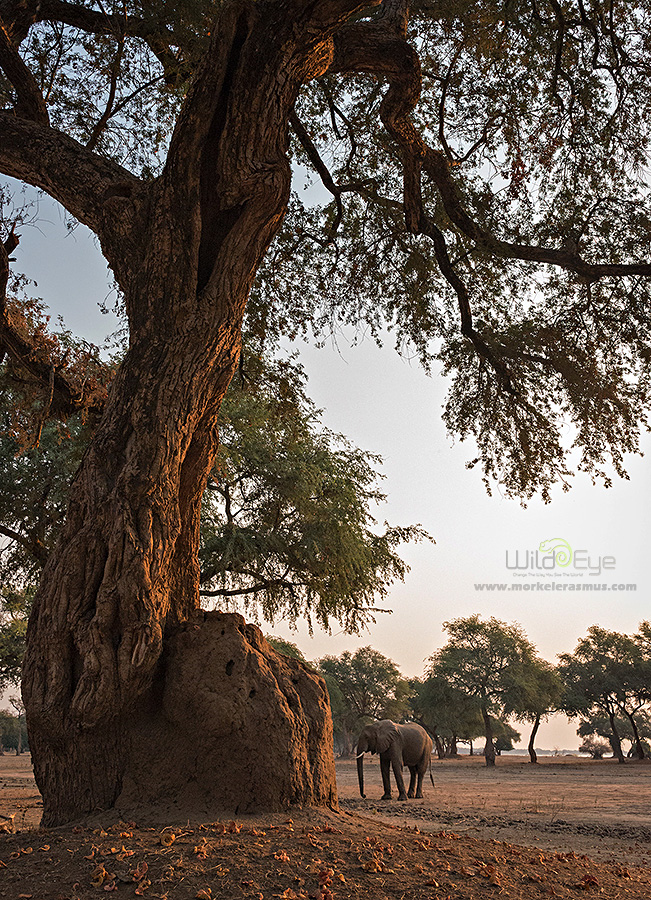
Well, I want to show you a photo taken IN Mana Pools showing the BIG picture.
It's an elephant photo, but it's not really in principle just about an elephant - got it?
First, have a look, and then I will discuss it...
I captured this photo alongside my guests as I hosted a Wild Eye photographic safari in conjunction with Mwinilunga Safaris in Mana Pools.
You see, as I explained in this post, my fascination with Mana Pools goes far deeper than just the wonderful experiences that can be had walking with the elephants, lions, wild dogs etc. It's also the ethereal beauty of these floodplain-forests and the immense and gnawed Faidherbia Albida (Winterthorn) trees that dot the landscape that has me in awe.
What I was going for with this composition and perspective that actually diminishes the elephant was that encompassing sense of beauty and awe, where the elements themselves combine with the wildlife to create a sense of what I was experiencing myself in this moment as I was crouching behind the base of the tree with the termite mound around it - closer to the elephant than I was to the perceived safety of our Land Rover...
It's not primarily about the elephant. It's about the tree(s), the mood and the moment my guests and I experienced.
I'd like to think I achieved that.
I'd also like to know what YOU think...
Drop me a comment, tell me what this photo does for you!
Until next time,
Morkel Erasmus
1. I love Mana Pools in Zimbabwe.
2. I love showing the bigger picture in my wildlife photos.
Well, I want to show you a photo taken IN Mana Pools showing the BIG picture.
It's an elephant photo, but it's not really in principle just about an elephant - got it?
First, have a look, and then I will discuss it...
![]() |
| Nikon D800 | Nikkor 24-70mm f2.8 | Circular Polariser | f16 | 1/160 SS | ISO-6400 |
I captured this photo alongside my guests as I hosted a Wild Eye photographic safari in conjunction with Mwinilunga Safaris in Mana Pools.
You see, as I explained in this post, my fascination with Mana Pools goes far deeper than just the wonderful experiences that can be had walking with the elephants, lions, wild dogs etc. It's also the ethereal beauty of these floodplain-forests and the immense and gnawed Faidherbia Albida (Winterthorn) trees that dot the landscape that has me in awe.
What I was going for with this composition and perspective that actually diminishes the elephant was that encompassing sense of beauty and awe, where the elements themselves combine with the wildlife to create a sense of what I was experiencing myself in this moment as I was crouching behind the base of the tree with the termite mound around it - closer to the elephant than I was to the perceived safety of our Land Rover...
It's not primarily about the elephant. It's about the tree(s), the mood and the moment my guests and I experienced.
I'd like to think I achieved that.
I'd also like to know what YOU think...
Drop me a comment, tell me what this photo does for you!
Until next time,
Morkel Erasmus
Monday, 30 March 2015
Death Dance
Sometimes you spend hours waiting for a specific photo, anticipating and watching for the decisive moment in sweltering heat...other times you just stumble into the right spot at the right time.
I wish I could wax lyrical about the planning and preparation that went into capturing this moment, but I can't. It was a combination of right time/place and luck (we all need some luck in this thing called wildlife photography!). During our 2013 +Wild Eye Great Migration photo safari I hosted with +Marlon du Toit, we saw some lions lying in the grass next to the Mara river, and decided to head closer for some portrait photography. As we pulled to a stop, to our amazement a lone wildebeest scrambled up the riverbank (having just done a solo crossing we couldn't see from our vantage point), and the poor thing literally almost tripped over the lions. The largest female of the small pride wasted no time in pouncing on the unfortunate ungulate, and a lengthy struggle ensued during which we were privy to the emotional dance of death between these species that occurs during the Great Migration.
This particular wildebeest didn't seem to want to give up and kept struggling to escape his attackers, but to no avail. We were very close to the action, and shooting with a 500mm lens forced me to compose a little out-of-the-box, but I liked how it came out!
Let me know which you prefer by dropping a comment below.
Thanks for stopping by! I hope you have a great week...
If you would like to join us in the Mara Triangle this year for an awesome photographic adventure, then check out THIS page.
If you would like to purchase this tone version as a limited edition fine art print for your office or home, mail me: morkel@morkelerasmus.com
Morkel Erasmus
I wish I could wax lyrical about the planning and preparation that went into capturing this moment, but I can't. It was a combination of right time/place and luck (we all need some luck in this thing called wildlife photography!). During our 2013 +Wild Eye Great Migration photo safari I hosted with +Marlon du Toit, we saw some lions lying in the grass next to the Mara river, and decided to head closer for some portrait photography. As we pulled to a stop, to our amazement a lone wildebeest scrambled up the riverbank (having just done a solo crossing we couldn't see from our vantage point), and the poor thing literally almost tripped over the lions. The largest female of the small pride wasted no time in pouncing on the unfortunate ungulate, and a lengthy struggle ensued during which we were privy to the emotional dance of death between these species that occurs during the Great Migration.
This particular wildebeest didn't seem to want to give up and kept struggling to escape his attackers, but to no avail. We were very close to the action, and shooting with a 500mm lens forced me to compose a little out-of-the-box, but I liked how it came out!
![]() |
| Nikon D3s | Nikkor 500mm f4 VR-II | f8.0 | 1/1250 SS | ISO-1400 |
I also converted it to monochrome, and I like it better in that medium. What do you think??
![]() |
| Nikon D3s | Nikkor 500mm f4 VR-II | f8.0 | 1/1250 SS | ISO-1400 |
Let me know which you prefer by dropping a comment below.
Thanks for stopping by! I hope you have a great week...
If you would like to join us in the Mara Triangle this year for an awesome photographic adventure, then check out THIS page.
If you would like to purchase this tone version as a limited edition fine art print for your office or home, mail me: morkel@morkelerasmus.com
Morkel Erasmus
Tuesday, 27 January 2015
Elephant in the Mara
Hello everyone. I've been a bit flooded of late so blog posts have been sparse.
In the beginning of the month, I published a collection of images from my 2014 "photographic year". Though I always do this and view it as a useful way to assess my growth and artistic voice, I purposefully posted only images taken at 100mm focal length or less. You can read the entire post HERE.
The image I am sharing today NEARLY made the cut in that post.
During our +Wild Eye photographic safari to experience the Great Migration in the Mara Triangle in September 2014, we spent some time with a gentle yet impressive African Elephant bull who was leisurely grazing on the long red oat grass along the Mara river. He was right next to our vehicle so I was able to inspire my guests to really work the scene with their wide angle lenses. I am a sucker for an "animalscape" and having a circular polariser in front of my lens helped bring out more detail in the sky and tame some of the harsh late morning light.
Techs:
Nikon D800
Nikkor 24-70mm f2.8 @ 24mm
Kenko Pro Circular Polariser
f4.0 | 1/400 SS | ISO-100
Do you enjoy seeing photos like this? Or do you prefer the animal to be larger in the frame?
Let me know - drop me a comment on this post and let's discuss...
Morkel Erasmus
In the beginning of the month, I published a collection of images from my 2014 "photographic year". Though I always do this and view it as a useful way to assess my growth and artistic voice, I purposefully posted only images taken at 100mm focal length or less. You can read the entire post HERE.
The image I am sharing today NEARLY made the cut in that post.
During our +Wild Eye photographic safari to experience the Great Migration in the Mara Triangle in September 2014, we spent some time with a gentle yet impressive African Elephant bull who was leisurely grazing on the long red oat grass along the Mara river. He was right next to our vehicle so I was able to inspire my guests to really work the scene with their wide angle lenses. I am a sucker for an "animalscape" and having a circular polariser in front of my lens helped bring out more detail in the sky and tame some of the harsh late morning light.
Techs:
Nikon D800
Nikkor 24-70mm f2.8 @ 24mm
Kenko Pro Circular Polariser
f4.0 | 1/400 SS | ISO-100
Do you enjoy seeing photos like this? Or do you prefer the animal to be larger in the frame?
Let me know - drop me a comment on this post and let's discuss...
Morkel Erasmus
Thursday, 4 September 2014
A sense of Mana
I have just returned from hosting a Wild Eye photographic safari to a place that is cemented more and more firmly as my favourite piece of African wilderness after every visit. I thought of calling this photo "a sense of place", but it could actually only be one place, and that's Mana Pools...hence "a sense of Mana" felt more apt.
I don't often get to use my wide-angle lenses in a wildlife context. You have to get really close to the animals, and you have to be able to shift your perspective and composition almost without barriers...and photographing from a vehicle just restricts you in those terms. Being on foot with the wildlife of Mana Pools is a totally different story, though. Many of the elephants are very relaxed around humans if you behave in the appropriate way and approach them in the right way (a qualified guide is recommended).
On this afternoon as the sun set in a hazy sky over the Zambezi river, our group was able to get close to a young male as he fed from the pods that are falling from the albida trees at this time of year. I let the landscape photographer in me dictate what I was doing here - working with the starburst of the sun peeping around the edge of the closest tree, and framing wide to provide a sense of context and place. For me, these images speak louder than full-frame portraits of your subject. I like the idea of reducing the animal from the main subject to just one of the elements in a scene that is all about the essence of the place you are visiting...where the sum of the parts is greater than the whole.
This image is a single exposure, captured while crouching to obtain a lower perspective relative to the earth and the trees, without losing the sense of the Zambezi river in the background. The elephant was quite close, but the focal length belies that in the distortion/perspective. What do you think?
Techs:
Nikon D800
Nikkor 24-70mm f2.8
f22 | 1/160 SS | ISO-4000
I cannot more highly recommend this destination for the serious African wilderness aficionado and wildlife photographer. No other place feels quite the same after a visit to Mana! I absolutely loved seeing my guests on this past safari being infused with this same awe and love for this piece of unique wilderness.Our 2015 safaris to Mana Pools have now been extended to 5 nights, and return charter flights between Harare and Mana Pools are also included, as getting there by road from Harare just takes too much time that could rather be spent in the field (it's an all day affair if you have to be driven to Mana). Check out all the dates and details HERE...
Thanks for reading! Have a pleasant day, friends.
Morkel Erasmus
I don't often get to use my wide-angle lenses in a wildlife context. You have to get really close to the animals, and you have to be able to shift your perspective and composition almost without barriers...and photographing from a vehicle just restricts you in those terms. Being on foot with the wildlife of Mana Pools is a totally different story, though. Many of the elephants are very relaxed around humans if you behave in the appropriate way and approach them in the right way (a qualified guide is recommended).
On this afternoon as the sun set in a hazy sky over the Zambezi river, our group was able to get close to a young male as he fed from the pods that are falling from the albida trees at this time of year. I let the landscape photographer in me dictate what I was doing here - working with the starburst of the sun peeping around the edge of the closest tree, and framing wide to provide a sense of context and place. For me, these images speak louder than full-frame portraits of your subject. I like the idea of reducing the animal from the main subject to just one of the elements in a scene that is all about the essence of the place you are visiting...where the sum of the parts is greater than the whole.
This image is a single exposure, captured while crouching to obtain a lower perspective relative to the earth and the trees, without losing the sense of the Zambezi river in the background. The elephant was quite close, but the focal length belies that in the distortion/perspective. What do you think?
Techs:
Nikon D800
Nikkor 24-70mm f2.8
f22 | 1/160 SS | ISO-4000
![]() |
| click on the image to view at optimal resolution and sharpness |
I cannot more highly recommend this destination for the serious African wilderness aficionado and wildlife photographer. No other place feels quite the same after a visit to Mana! I absolutely loved seeing my guests on this past safari being infused with this same awe and love for this piece of unique wilderness.Our 2015 safaris to Mana Pools have now been extended to 5 nights, and return charter flights between Harare and Mana Pools are also included, as getting there by road from Harare just takes too much time that could rather be spent in the field (it's an all day affair if you have to be driven to Mana). Check out all the dates and details HERE...
Thanks for reading! Have a pleasant day, friends.
Morkel Erasmus
Labels:
Africa,
albida,
animalscape,
context,
elephant,
floodplains,
golden light,
haze,
landscape,
Mana Pools,
mood,
nature,
safari,
story,
trees,
Wild Eye,
Zambezi,
Zimbabwe
Wednesday, 27 August 2014
The Dogs of Mana Pools
On Friday morning I depart for my favourite part of Africa - Mana Pools National Park in Zimbabwe. I am hosting a Wild Eye photographic safari to this pristine and ethereal wilderness area, and I am quite excited to return there...
During our maiden voyage to Mana, my buddy Marlon du Toit and I were fortunate to spend some quality time with one of the local packs of African Wild Dogs (also called Cape Hunting Dogs or Painted Wolves). Mana Pools is a stronghold for this species, the most endangered of Africa's predators (fewer than 4000 remain in the wild).
We located the pack again on our last afternoon of the trip, sunning themselves in a dry riverbed. We decided to venture a bit closer, and to do so meant we had to physically leopard-crawl over the coarse river sand for about 40 painstaking meters, with bare elbows and knees, carrying our cameras equipped with super telephoto lenses in one hand and our beanbags in the other hand. Progress was slow, as the going was tough and we also didn't want to cause the canines distress. When we were in a good position, still not too close to cause distress, we settled in and spent some time photographing their lazy antics.
Eventually, the alpha male got a whiff of us as the wind direction shifted. He immediately came closer to investigate. It was thrilling to look through the viewfinder as he bore down on us slowly, checking us out.
When he was too close for my lens to focus, I looked up, and looked him in the eye.
He walked around us, taking in our scent, and after ascertaining that we were not a threat to his pack, he did the unthinkable - he flopped down a mere 15 meters from where we were still lying motionless.
It was epic.
It was a moment that forever changed the way I see wildlife photography (well, that whole Mana Pools trip changed the way I see wildlife photography, to be honest).
To make such a direct connection with our subject was a revelation to myself and to Marlon.
We came back and vowed to share the "Mana Magic" with others.
On Friday I am going back to do just that...and hopefully the Dogs will be obliging again!
If you want to join us on our adventures in Mana Pools in 2015, then check out the details HERE.
Thanks, as always, for reading my ramblings. I'll catch you on the flipside!
Morkel Erasmus
During our maiden voyage to Mana, my buddy Marlon du Toit and I were fortunate to spend some quality time with one of the local packs of African Wild Dogs (also called Cape Hunting Dogs or Painted Wolves). Mana Pools is a stronghold for this species, the most endangered of Africa's predators (fewer than 4000 remain in the wild).
We located the pack again on our last afternoon of the trip, sunning themselves in a dry riverbed. We decided to venture a bit closer, and to do so meant we had to physically leopard-crawl over the coarse river sand for about 40 painstaking meters, with bare elbows and knees, carrying our cameras equipped with super telephoto lenses in one hand and our beanbags in the other hand. Progress was slow, as the going was tough and we also didn't want to cause the canines distress. When we were in a good position, still not too close to cause distress, we settled in and spent some time photographing their lazy antics.
Eventually, the alpha male got a whiff of us as the wind direction shifted. He immediately came closer to investigate. It was thrilling to look through the viewfinder as he bore down on us slowly, checking us out.
![]() |
| Nikon D3s | Nikkor 500mm f4 VR-II | 1.4x teleconverter | f6.3 | 1/320 SS | ISO-4000 |
When he was too close for my lens to focus, I looked up, and looked him in the eye.
![]() |
| Nikon D3s | Nikkor 500mm f4 VR-II | 1.4x teleconverter | f6.3 | 1/320 SS | ISO-7200 |
He walked around us, taking in our scent, and after ascertaining that we were not a threat to his pack, he did the unthinkable - he flopped down a mere 15 meters from where we were still lying motionless.
It was epic.
It was a moment that forever changed the way I see wildlife photography (well, that whole Mana Pools trip changed the way I see wildlife photography, to be honest).
![]() |
| Nikon D3s | Nikkor 500mm f4 VR-II | f5.6 | 1/400 SS | ISO-2500 |
To make such a direct connection with our subject was a revelation to myself and to Marlon.
We came back and vowed to share the "Mana Magic" with others.
On Friday I am going back to do just that...and hopefully the Dogs will be obliging again!
If you want to join us on our adventures in Mana Pools in 2015, then check out the details HERE.
Thanks, as always, for reading my ramblings. I'll catch you on the flipside!
Morkel Erasmus
Wednesday, 11 June 2014
Beach Elephants
I can't believe I haven't posted this photo on my blog before - but oh well, here it is. It looks like a pristine beach with idyllic white sand, but it is in fact the riverbed of the mighty Zambezi river flowing between Zimbabwe and Zambia at this point. I was sitting on the bank of the river in Mana Pools National Park (Zimbabwe), and you can see the escarpment of the Lower Zambezi Valley in Zambia rising up across the river.
The late afternoon light, combined with the hazy skies due to winter veld fires burning on the Zambian side, gave an otherworldly blissful feel to this, and this certainly echoes what I felt on this first afternoon of my first trip to this magical piece of wilderness.
I am returning on 29 August 2014 hosting a 4-night photographic safari with Wild Eye and Mwinilunga Safaris, and I can't wait. There is still a spot or two open for those keen to experience and photograph the magic of Mana Pools - you can find all the details you need HERE.
Techs:
Nikon D7000
Nikkor 70-200mm f2.8 VR-II @ 120mm
f5.6 | 1/500 SS | ISO-640
Exposure Bias +0.7
Thanks for taking the time to have a look!
Morkel Erasmus
The late afternoon light, combined with the hazy skies due to winter veld fires burning on the Zambian side, gave an otherworldly blissful feel to this, and this certainly echoes what I felt on this first afternoon of my first trip to this magical piece of wilderness.
I am returning on 29 August 2014 hosting a 4-night photographic safari with Wild Eye and Mwinilunga Safaris, and I can't wait. There is still a spot or two open for those keen to experience and photograph the magic of Mana Pools - you can find all the details you need HERE.
Techs:
Nikon D7000
Nikkor 70-200mm f2.8 VR-II @ 120mm
f5.6 | 1/500 SS | ISO-640
Exposure Bias +0.7
![]() |
| please click on the photo to view at the proper resolution and sharpness |
Thanks for taking the time to have a look!
Morkel Erasmus
Sunday, 8 June 2014
An elusive Kingfisher
I haven't shown you a bird in quite a while - so I'll remedy that situation right here and now! Southern Africa is blessed with a lovely variety of Kingfishers, a species that is a firm favourite with avid bird-watchers and photographers in most parts of the world, for sure.
I've had good opportunities in the past to photograph the more commonly found species in our region - the Malachite, Pied and Woodlands Kingfishers (and I've even had some good sightings of the Giant Kingfisher) - but there are 3 that have eluded me thus far in terms of getting a nice usable photo. These are the Half-collared Kingfisher, the African Pygmy Kingfisher and the Brown-hooded Kingfisher.
Well, one of them can now be taken off the "never photographed" list. On the recent Wild Eye Chobe Photographic Safari that I hosted, we were able to get nice and close to a Brown-hooded Kingfisher that had a nest in the bank of the Chobe river. Lighting conditions were challenging as it was at the end of the day in the shade of a large tree, but we all got some portraits we can be pretty pleased with.
Next up - to find the Half-collared and Pygmy!!
Techs:
Nikon D800
Nikkor 500mm f4 VR-II
f4.0 | 1/1000 SS | ISO-1800
Thanks for looking, and I hope you have a wonderful week ahead of you. I will be heading to the exciting new photographic reserve called ZIMANGA later in this week, where a number of photographic hides have been built and many more are in planning. Keep your eyes on my blog and social media channels as I share some images (which will surely include many beautiful birds) upon my return.
Morkel Erasmus
I've had good opportunities in the past to photograph the more commonly found species in our region - the Malachite, Pied and Woodlands Kingfishers (and I've even had some good sightings of the Giant Kingfisher) - but there are 3 that have eluded me thus far in terms of getting a nice usable photo. These are the Half-collared Kingfisher, the African Pygmy Kingfisher and the Brown-hooded Kingfisher.
Well, one of them can now be taken off the "never photographed" list. On the recent Wild Eye Chobe Photographic Safari that I hosted, we were able to get nice and close to a Brown-hooded Kingfisher that had a nest in the bank of the Chobe river. Lighting conditions were challenging as it was at the end of the day in the shade of a large tree, but we all got some portraits we can be pretty pleased with.
Next up - to find the Half-collared and Pygmy!!
Techs:
Nikon D800
Nikkor 500mm f4 VR-II
f4.0 | 1/1000 SS | ISO-1800
Thanks for looking, and I hope you have a wonderful week ahead of you. I will be heading to the exciting new photographic reserve called ZIMANGA later in this week, where a number of photographic hides have been built and many more are in planning. Keep your eyes on my blog and social media channels as I share some images (which will surely include many beautiful birds) upon my return.
Morkel Erasmus
Thursday, 24 April 2014
The Chobe River in Monochrome
Seeing that I recently returned from leading a photographic safari to the Chobe river, I thought I would post a link to a blog post I wrote early in 2013 for the Wild Eye blog, showing some of my visions of the Chobe in monochrome after our first visit to the Ichobezi houseboat on the river.
You can read the original post HERE.
Morkel Erasmus
You can read the original post HERE.
Morkel Erasmus
Labels:
Africa,
black and white,
Botswana,
Chobe,
monochrome,
mood,
River,
safari,
throwback,
Travel,
Wild Eye
Wednesday, 16 April 2014
Hippo Foursome
Hey everyone! Here's a quick photo to share with you from my recent safari to the Chobe river in Botswana. You can catch up on all the detailed trip reports over on the Wild Eye blog:
Part 1
Part 2
Part 3
Part 4
As we were cruising along the Chobe river that straddles the Chobe National Park in Botswana and the Caprivi strip in Namibia, we came across a pod of Hippopotamus who were out of the river quite late in the morning. Hippo usually come out to graze at night and return to the water as the day breaks.
My guests and I were able to capture a couple of lovely photos of these youngsters lazily standing on the riverbank, not entirely committed to getting wet just yet. Some of them looked like they were standing up sleeping, in fact. We were able to maneuver nicely with our specialised photographic boat for lovely photographic opportunities, even as they eventually stepped into the water.
Techs:
Nikon D3s
Nikkor 500mm f4 VR-II
1.4x teleconverter
f8.0 | 1/1250 SS | ISO-2500
Part 1
Part 2
Part 3
Part 4
As we were cruising along the Chobe river that straddles the Chobe National Park in Botswana and the Caprivi strip in Namibia, we came across a pod of Hippopotamus who were out of the river quite late in the morning. Hippo usually come out to graze at night and return to the water as the day breaks.
My guests and I were able to capture a couple of lovely photos of these youngsters lazily standing on the riverbank, not entirely committed to getting wet just yet. Some of them looked like they were standing up sleeping, in fact. We were able to maneuver nicely with our specialised photographic boat for lovely photographic opportunities, even as they eventually stepped into the water.
Techs:
Nikon D3s
Nikkor 500mm f4 VR-II
1.4x teleconverter
f8.0 | 1/1250 SS | ISO-2500
![]() |
| click on the photo to view at optimal sharpness and resolution |
Morkel Erasmus
Thursday, 3 April 2014
A Day in Mana Pools
I mince no bones about the fact that I absolutely love Mana Pools.
It is currently (and will probably remain for a long time) my favourite safari destination in Africa.
This is an older post of mine over on the Wild Eye Photo Chat blog, describing how a potential day on safari with us in Mana Pools might go. Just looking at it again makes me yearn to be back there!
You can read the original post, with plenty of eye candy in the form of photos, HERE.
You can also find out more information about joining me in Mana Pools on a safari ini 2014 HERE.
Have a great day, friends...
Morkel Erasmus
It is currently (and will probably remain for a long time) my favourite safari destination in Africa.
This is an older post of mine over on the Wild Eye Photo Chat blog, describing how a potential day on safari with us in Mana Pools might go. Just looking at it again makes me yearn to be back there!
You can read the original post, with plenty of eye candy in the form of photos, HERE.
You can also find out more information about joining me in Mana Pools on a safari ini 2014 HERE.
Have a great day, friends...
Morkel Erasmus
Labels:
Africa,
dreaming,
guest blog,
Mana Pools,
nature,
pristine,
sightings,
Travel,
UNESCO,
Wild Eye,
wilderness,
wildlife,
Zambezi,
Zimbabwe
Thursday, 27 March 2014
A quick and powerful processing tip
Many of you will know that I present a popular post-processing workshop for wildlife photographers in South Africa. Obviously, if you don't live in our country it's hard for you to attend one of these.
While the +Wild Eye office team and I are working on a way to enable remote attendance of these workshops, you may be hungry for quick processing tips that will aid your processing workflow.
Here's a post I wrote for the Wild Eye Photo Chat Blog, detailing one of my favourite techniques for adding "punch" to your wildlife and nature photos. It's called "Local Contrast Enhancement". Much credit for the way I apply this method goes to my friend Robert Amoruso from the USA (www.wildscapeimages.biz).
While the +Wild Eye office team and I are working on a way to enable remote attendance of these workshops, you may be hungry for quick processing tips that will aid your processing workflow.
Here's a post I wrote for the Wild Eye Photo Chat Blog, detailing one of my favourite techniques for adding "punch" to your wildlife and nature photos. It's called "Local Contrast Enhancement". Much credit for the way I apply this method goes to my friend Robert Amoruso from the USA (www.wildscapeimages.biz).
![]() |
| Before and After versions of a photo with LCE applied |
I hope you find it helpful. If you are struggling to apply this or have any questions, feel free to drop me a comment here or on the original post.
Morkel Erasmus
Thursday, 20 March 2014
Rowdy Family
Who doesn't love a cute picture of primates? Chacma Baboons nearly always provide for some adorable, funny and interesting moments to be captured on camera, and this was certainly the case recently on the Chobe river. We were able to drift very close with the Wild Eye photographic boat when we were photographing a number of baboon troops along the banks of the river, especially in the early mornings.
This frame really needs no explanation - it was a special moment and my guests and I were able to isolate these four from the rest of the troop using correct framing/composition. Can you think of an apt caption for this? What would the "parents" be thinking? Leave a comment if you have a quirky one...
Techs:
Nikon D800
Nikkor 500mm f4 VR-II
f4.0 | 1/200 SS | ISO-3200
Morkel Erasmus
This frame really needs no explanation - it was a special moment and my guests and I were able to isolate these four from the rest of the troop using correct framing/composition. Can you think of an apt caption for this? What would the "parents" be thinking? Leave a comment if you have a quirky one...
Techs:
Nikon D800
Nikkor 500mm f4 VR-II
f4.0 | 1/200 SS | ISO-3200
![]() |
| click on the photo to display at optimal resolution and sharpness |
Morkel Erasmus
Wednesday, 26 February 2014
About those roads...
If you’ve ever visited Southern African National Parks and Game Reserves, you would have encountered animals on roads. Many in the photographic fraternity frown upon including the road in
your photos, as it detracts from the ‘natural look’ of the image.
I’ve got a few thoughts on this...and you can read them HERE on the Wild Eye Photo Chat blog.
Have a great week...
Morkel Erasmus
I’ve got a few thoughts on this...and you can read them HERE on the Wild Eye Photo Chat blog.
Have a great week...
Morkel Erasmus
Saturday, 11 January 2014
Are you a lion snob?
What do I mean by that?
Simply this – are you always chasing after the next “big thing” when you’re in the bush?
Doing this often makes you miss many of the smaller wonders of Africa, and besides this it can frustrate the living daylights out of you when you don’t find that “big thing”.
For more of my musings on this topic, check out this earlier post on the Wild Eye blog.
What are your thoughts? Drop me a comment...
Morkel Erasmus
Simply this – are you always chasing after the next “big thing” when you’re in the bush?
Doing this often makes you miss many of the smaller wonders of Africa, and besides this it can frustrate the living daylights out of you when you don’t find that “big thing”.
For more of my musings on this topic, check out this earlier post on the Wild Eye blog.
What are your thoughts? Drop me a comment...
Morkel Erasmus
Labels:
advice,
Africa,
diversity,
game drive,
game viewing,
lion,
safari,
snob,
Travel,
Wild Eye,
wildlife
Sunday, 5 January 2014
Seeing Double
or…“What to do with those animals that won’t stay out of your frame in the background!”
Many people like photographing their wildlife subjects against clean backgrounds with minimal distractions. There are even some that lambaste the presence of other out-of-focus animals in the frame as being “distracting”. Given, they CAN be distracting if they are not adding to the overall story and context and composition, especially if they are not easily discernible or criss-crossing behind your subject in certain ways.
To read a short photographic essay I wrote about this concept - with many more images, check out THIS POST on the Wild Eye Photo Chat blog.
Keep well, until I write to you again!
Morkel Erasmus
Many people like photographing their wildlife subjects against clean backgrounds with minimal distractions. There are even some that lambaste the presence of other out-of-focus animals in the frame as being “distracting”. Given, they CAN be distracting if they are not adding to the overall story and context and composition, especially if they are not easily discernible or criss-crossing behind your subject in certain ways.
To read a short photographic essay I wrote about this concept - with many more images, check out THIS POST on the Wild Eye Photo Chat blog.
Keep well, until I write to you again!
Morkel Erasmus
Labels:
advice,
hints,
nature,
Photography,
techniques,
thoughts,
tips,
Wild Eye,
wildlife
Monday, 4 November 2013
Mara Mayhem
This photo was taken on a morning where we witnessed our first proper (and by that I mean sheer numbers) wildebeest crossing of the Mara river in Kenya. The herds were building on the Mara Triangle side and we knew that crossings were imminent. We had to drive around to the Masai Mara Reserve side to get them coming towards us, unfortunately. By the time we got to the opposite side one of the groups had already crossed halfway. Fortunately, we were in for 3 more crossings from these precarious banks.
Capturing this event on camera is nothing new. Many people have done so. We reminded our guests to also take in the scene without cameras - the sights, the smells, the sounds - so as not to get glued to the camera and miss the forest for the trees so to speak. Taking a "unique" photo of this dramatic event is hard, as so many great photographers have been here through the years. I merely tried to capture what I saw well. In this shot, I framed vertically to get the "lines" of wildebeest coming down to cross. I also used a very slow shutter speed to blur some of the movement and hopefully get other wildebeests still sharp enough. I think it worked - do you?
Techs:
Nikon D3s
Nikkor 500mm f4 VR-II
f16 | 1/80 SS | ISO-360
If you would like to join me in photographing this madness next year, you can check out our 2014 Wild Eye Migration packages HERE.
Thanks for viewing and reading! If you like my posts, please share my blog with your friends.
Morkel Erasmus
Capturing this event on camera is nothing new. Many people have done so. We reminded our guests to also take in the scene without cameras - the sights, the smells, the sounds - so as not to get glued to the camera and miss the forest for the trees so to speak. Taking a "unique" photo of this dramatic event is hard, as so many great photographers have been here through the years. I merely tried to capture what I saw well. In this shot, I framed vertically to get the "lines" of wildebeest coming down to cross. I also used a very slow shutter speed to blur some of the movement and hopefully get other wildebeests still sharp enough. I think it worked - do you?
Techs:
Nikon D3s
Nikkor 500mm f4 VR-II
f16 | 1/80 SS | ISO-360
![]() |
| click on the photo to display properly |
If you would like to join me in photographing this madness next year, you can check out our 2014 Wild Eye Migration packages HERE.
Thanks for viewing and reading! If you like my posts, please share my blog with your friends.
Morkel Erasmus
Tuesday, 22 October 2013
Graceful Wings
There are few birds in Africa that evoke more in us than the African Fish Eagle. It has been my favourite raptor for years, and their haunting calls along Africa's waterways are an amazing reminder of the privilege we have to be on safari.
One of the best places to see and photograph them is on the Chobe river in Botswana. You can join us on a Wild Eye safari to this amazing oasis of wildlife where we will use a specialised photographic boat fitted with rotating chairs and mounted gimbal heads for your long lens, while based on a luxurious houseboat that can moor deep into the Chobe National Park for special access to key parts of the river in good light when other operators need to move out to make the "gate times". There's one date left in 2013 but 2014 dates are already laid out - I will be leading a trip from 12-16 March 2014. You can book and see all the details and info (plus images of the boat and houseboat) HERE.
This image was taken from the Wild Eye photographic boat. I just love how the light reflected off the water displays on the bird's open wings.
Techs:
Nikon D3s
Nikkor 500mm f4 VR-II
f8.0 | 1/2000 SS | ISO-2500
Exposure Bias +0.7
Have a great day, friends!
Morkel Erasmus
One of the best places to see and photograph them is on the Chobe river in Botswana. You can join us on a Wild Eye safari to this amazing oasis of wildlife where we will use a specialised photographic boat fitted with rotating chairs and mounted gimbal heads for your long lens, while based on a luxurious houseboat that can moor deep into the Chobe National Park for special access to key parts of the river in good light when other operators need to move out to make the "gate times". There's one date left in 2013 but 2014 dates are already laid out - I will be leading a trip from 12-16 March 2014. You can book and see all the details and info (plus images of the boat and houseboat) HERE.
![]() |
| click on the photo to display properly |
This image was taken from the Wild Eye photographic boat. I just love how the light reflected off the water displays on the bird's open wings.
Techs:
Nikon D3s
Nikkor 500mm f4 VR-II
f8.0 | 1/2000 SS | ISO-2500
Exposure Bias +0.7
Have a great day, friends!
Morkel Erasmus
Labels:
Africa,
bird,
boat,
Botswana,
Chobe,
fish eagle,
flight,
nature,
photographic safari,
raptor,
River,
specialised,
Wild Eye,
wildlife,
wings
Sunday, 6 October 2013
Jumpers
I suppose at some point it had to come...the obligatory photo of a wildebeest crossing, stock standard from every person who makes the pilgrimage to see this spectacle. I thought a lot about how to approach these scenes (from the comfort of my office chair) before the trip, but let me tell you - when the moment arrives, you just bore down to base photographic instinct and shoot. There's very little time to really think your composition through, very little time to compensate via settings for a specific mood and feel, and very little time for much more than just looking for an opportunity in this chaos to make an interesting image.
I hope this image is one you find interesting. This particular crossing had some precarious ledges and drops that the wildebeest had to negotiate. My guests and I played around with various shutter speed settings throughout the sighting to ensure good variety and a difference in how the chaos was portrayed. In this one I was using a faster shutter speed. Overcast conditions helped to tame the strong contrast and harsh shadows you normally see in these scenes.
Techs:
Nikon D3s
Nikkor 500mm f4 VR-II
f11 | 1/1250 SS | ISO-2000
If you would like to join us in the Mara Triangle with Wild Eye next year, you can add your name to the waiting list for the dates that go live on 1 November 2013.
Cheers!
Morkel Erasmus
I hope this image is one you find interesting. This particular crossing had some precarious ledges and drops that the wildebeest had to negotiate. My guests and I played around with various shutter speed settings throughout the sighting to ensure good variety and a difference in how the chaos was portrayed. In this one I was using a faster shutter speed. Overcast conditions helped to tame the strong contrast and harsh shadows you normally see in these scenes.
Techs:
Nikon D3s
Nikkor 500mm f4 VR-II
f11 | 1/1250 SS | ISO-2000
![]() |
| click on the photo to display properly |
If you would like to join us in the Mara Triangle with Wild Eye next year, you can add your name to the waiting list for the dates that go live on 1 November 2013.
Cheers!
Morkel Erasmus
Tuesday, 1 October 2013
Tails and Horns
If you've ever tried to photograph a cheetah hunt, then you would know that it's over in a flash, and you often just can't track the movement changes of the chase well enough. During our recent Wild Eye Great Migration Photographic Safari in the Mara Triangle (Kenya), we pulled into a cheetah sighting just as the hunt was about to begin. I quickly told the guests with me which settings to dial into their cameras, as I know from past experience that shutter speed and aperture need to be protected in these cases, and ISO should be the one to sacrifice.
As the chase began, the female Cheetah chased the Thomson's Gazelle right past the nose of our customised Toyota Land Cruiser and then the take-down happened exactly 30 meters from our shooting position. Those of you who know me know that I photograph wildlife action primarily with the Nikkor 500mm prime telephoto lens. With it not being a zoom lens, getting the action too close can be a concern...
This photo is one of the sequence I captured last week. It's not perfect - why?
Is it the light? The light is a bit harsh, mid morning actually - but it was slightly overcast so I think it came out nicely, so no.
It's the framing, right? Because the gazelle's one horn is "clipped" on the right of the frame. It's full frame on that end, I actually ended up cropping a wee bit from the left and bottom to frame the overall action better.
Does it still work?
I think it does. Besides my obvious emotional connection to an action image like this which really portrays a split second in a frenetic life-and-death tussle...I think the horn is less of an issue than the cheetah's tail, which is what I often end up "amputating" by poor framing. In this case, the cheetah's grace and power in the final take-down of the gazelle is the focus (not to take anything away from the "oh crap" expression on the prey's face)...so the horn becomes less of an issue.
What do you think? Would you ever delete a photo like this from your library because of the flaw I listed above? Drop me a comment below and share your thoughts!
Techs:
Nikon D3s
Nikkor 500mm f4 VR-II
f8.0 | 1/3200 SS | ISO-900
Until next time...
Morkel Erasmus
As the chase began, the female Cheetah chased the Thomson's Gazelle right past the nose of our customised Toyota Land Cruiser and then the take-down happened exactly 30 meters from our shooting position. Those of you who know me know that I photograph wildlife action primarily with the Nikkor 500mm prime telephoto lens. With it not being a zoom lens, getting the action too close can be a concern...
This photo is one of the sequence I captured last week. It's not perfect - why?
Is it the light? The light is a bit harsh, mid morning actually - but it was slightly overcast so I think it came out nicely, so no.
It's the framing, right? Because the gazelle's one horn is "clipped" on the right of the frame. It's full frame on that end, I actually ended up cropping a wee bit from the left and bottom to frame the overall action better.
Does it still work?
I think it does. Besides my obvious emotional connection to an action image like this which really portrays a split second in a frenetic life-and-death tussle...I think the horn is less of an issue than the cheetah's tail, which is what I often end up "amputating" by poor framing. In this case, the cheetah's grace and power in the final take-down of the gazelle is the focus (not to take anything away from the "oh crap" expression on the prey's face)...so the horn becomes less of an issue.
What do you think? Would you ever delete a photo like this from your library because of the flaw I listed above? Drop me a comment below and share your thoughts!
Techs:
Nikon D3s
Nikkor 500mm f4 VR-II
f8.0 | 1/3200 SS | ISO-900
![]() |
| click on the photo to display properly... |
Until next time...
Morkel Erasmus
Labels:
Africa,
chase,
cheetah,
gazelle,
hunt,
Kenya,
kill,
Masai Mara,
nature,
predator,
safari,
Wild Eye
Subscribe to:
Posts (Atom)