Showing posts with label Zimbabwe. Show all posts

Monday, 29 August 2016

Trust your Histogram

If you've been around decent caliber wildlife photographers for any length of time, you will no doubt have heard one of them admonish someone else to always watch their histogram. It's the final litmus test for ensuring our images come out as we intend in-the-field, right?

Yes.

The important thing to remember is that you need to look at the HISTOGRAM specifically.
The actual graph plotted for the data contained in your actual image.

DON'T trust the version of the image you see on the LCD screen, though.
The back-of-camera LCD is far from a calibrated monitor on which to decide whether the colour or even apparent exposure of the image looks correct.

It's easy to fall back on pure image review and forget to rely on data interpretation. Yes, of course the content of the image is important if you are reviewing or double-checking your composition - what I am referring to is exposure checking, especially in tricky and challenging lighting conditions.

Consider this image - RAW, straight conversion, no processing applied.


If, at first glance, you thought that I had way underexposed this photo, you were correct.
Yet, I had done it on purpose!

The setting was a glorious misty sunrise on the last morning of the +Wild Eye Mana Pools photo safari I hosted in July (read the TRIP REPORT). When the sun rose behind the trees as a muted fiery ball, I knew that I wanted a photo with everything decently exposed (even the sun). So I purposely underexposed enough to protect the highlights and shadows from excessive clipping, knowing from experience what I would be able to pull back and rescue in processing. I shoot Nikon, and the specific settings might not correlate with how you would need to expose with other cameras, but I used these settings:

Nikon D800 with Nikkor 300mm f2.8 VR-II Aperture: f5.6
Shutter Speed: 1/1000
ISO: 250
Exposure bias: -2/3

In this case, I specifically remember that I couldn't really see jack squat on my LCD in terms of composition or image content, the photo was simply too dark. I needed to trust my framing in the viewfinder and also my exposure based on histogram.

The resultant histogram:


Again you might think this is creeping up too much on the shadows and highlights ends of the histogram - and yet I posit to you that this is where knowing your gear comes in and knowing how much you can recover from certain tonal areas that may seem blown out at first.

A couple of delicate processing steps later:


In processing these photos I always try and go for a look & feel that would seem natural - if you were standing there looking into a hazy sunrise you would see detail, soft light and the scene would be oozing with mood. The original frame doesn't have that at face value, and we need to tease that out of the photo in processing. Remember that the human eye can process an equivalent of about 32 f-stops in one view, so a camera can never just capture the precise way in which we perceive a moody, high dynamic range scene like this.

It's easy to overcook this as well and make it look garishly unrealistic! 

The histogram now:


The brightest spots of the sun can be blown out - it's the sun after all.
The darkest shadows are not preventing me from enjoying the image for what is ought to be - a moody dawn in the forest.

The lesson?
Know your gear well enough to shoot on instinct. 
Know well enough what you want to capture to shoot on instinct.
If necessary, read the histogram and interpret what you need to change to bring you as close as possible to a USABLE image.

I hope this post has been of help to you.

Morkel Erasmus

Wednesday, 19 August 2015

Under the Winterthorns

If you have been following my work for a while you would know at least two things.

1. I love Mana Pools in Zimbabwe.
2. I love showing the bigger picture in my wildlife photos.

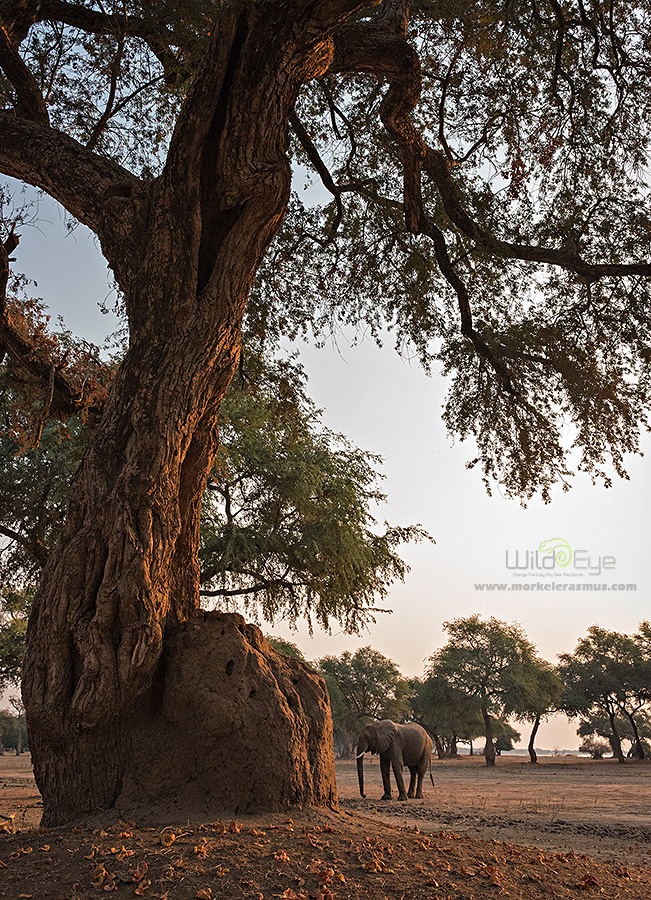
Well, I want to show you a photo taken IN Mana Pools showing the BIG picture.
It's an elephant photo, but it's not really in principle just about an elephant - got it?

First, have a look, and then I will discuss it...


Nikon D800  |  Nikkor 24-70mm f2.8  |  Circular Polariser  |  f16  |  1/160 SS  |  ISO-6400

I captured this photo alongside my guests as I hosted a Wild Eye photographic safari in conjunction with Mwinilunga Safaris in Mana Pools. 

You see, as I explained in this post, my fascination with Mana Pools goes far deeper than just the wonderful experiences that can be had walking with the elephants, lions, wild dogs etc. It's also the ethereal beauty of these floodplain-forests and the immense and gnawed Faidherbia Albida (Winterthorn) trees that dot the landscape that has me in awe.

What I was going for with this composition and perspective that actually diminishes the elephant was that encompassing sense of beauty and awe, where the elements themselves combine with the wildlife to create a sense of what I was experiencing myself in this moment as I was crouching behind the base of the tree with the termite mound around it - closer to the elephant than I was to the perceived safety of our Land Rover...

It's not primarily about the elephant. It's about the tree(s), the mood and the moment my guests and I experienced.

I'd like to think I achieved that.
I'd also like to know what YOU think...
Drop me a comment, tell me what this photo does for you!

Until next time,

Morkel Erasmus

Sunday, 4 January 2015

10 below 100 - my reflection on 2014

Good day folks! I bet the title of this blog post has you perplexed...

Since January 2010 I have made it a habit of posting a collection of my personal best moments in nature photography on my blog. I know some people scoff at this trend (obviously because many photographers seem to be doing it to get attention), but for me it really is a great way to take stock at the end of another calendar year and its accompanying travels/adventures, and also to assess where my personal expression in terms of photography is going. 

Am I growing as an artist? 
Am I changing the style and feel of my images subtly and subconsciously or boldly and consciously?
Am I putting out bland images and stagnating in my creativity?
Am I still enjoying what I do?
Do I primarily find joy and fulfillment in the work that I put out there?

These questions are constantly at the back of many artists' minds and doing these posts is a good way for me to try and answer them. The last one is paramount - we should primarily focus on producing a body of work that satisfies ourselves, if other people enjoy it then it should be a bonus. You can never cater for the majority of tastes out there, so it's prudent to first satisfy your own notions and tastes in the art that you produce...

Anyway - so this year has seen me really making a point of putting down the longer telephoto lens more often when doing wildlife photography. I have always immensely enjoyed landscape photography, and my previous years' reflective posts have included some outright landscape entries. I have also always had a knack for composing wildlife photos to include more of the environment and the scene in which the subject finds itself. We often harp about conserving the African wildlife, but in order to do that effectively we also need to place an emphasis on conserving the habitat, the ecosystems in which these species thrive. Habitat fragmentation is a big threat to most of the African biodiversity and it's a bigger problem year after year. 

This year I tried to create even more of these "animalscape" kind of images, and with shorter lenses too. Which brings me to the title of this post...

Instead of opting for another "best 20 shots of the year" divided into landscape, birds and wildlife (my 3 main subjects), I am going to post only 10 photos, all taken at focal lengths of 100mm or less. Yes, 10 photos of wildlife or landscapes or birds, all captured at focal lengths ranging between 14mm and 100mm. The short side of things. I hope this inspires you to reach for your shorter lenses more often - it's so easy to rely on the big guns to bring us tack sharp nicely isolated portraits of our wildlife subjects (in fact, if the winning images of this year's Natures Best competition are anything to go by, these kinds of tight portraits are probably coming back into fashion). 

So, like so many other wildlife photographers putting out their best work from 2014, I could have shown you frame-filling shots like these, showcasing how I used my super telephoto lens for the purpose it was built for:


While I do capture these kinds of portraits, and while they do look beautiful in many cases, I find that they also don't give context - they don't always scream "AFRICA!" to me - it's just where my personal taste has been going and growing in the past few years. The images I picked here were all taken by me, either hand-held or using a tripod (in the case of some landscape shots), using no fancy tools like remote control buggies and drones and selfie-sticks - just plain old photographer looking through the viewfinder...

So, without further a due, here are my 10 selections, with some back-story and technical info thrown into the mix. They are posted chronologically based on date of capture. To view the images at best resolution and sharpness - please do click on them...


1. "Chobe Crocscape"
During the Wild Eye Chobe Photo Safari I hosted in March, we came across a young Nile Crocodile basking in the morning sun on the banks of the Chobe river. We were able to position our photographic boat in such a way so as to make nice low angle close-up photos possible. I whipped out the 24-70mm lens with a polariser attached and made some "crocscape" images.


Nikon D800  |  Nikkor 24-70mm f2.8  @ 24mm  |  f5.6  |  1/500 SS  |  ISO-200  |  Kenko Pro Circular Polariser

2. "On Another Level"
On the same Chobe safari as above, we have a massive storm move through one afternoon, after which the air was crisp and clear and fresh. We spotted a herd of elephants moving down to the river to goof around, and set our photographic boat in that direction. We were able to coax the boat in gently quite close to where the young bulls were being boisterous in the water. I'm a sucker for low angle shots of wildlife, and if it can be low angle and wide angle, even more so. This is one frame from many we captured during that afternoon's session - my guests being inspired to also whip out their shorter lenses and make this moment count.


Nikon D800  |  Ni'kkor 24-70mm f2.8  @ 62mm  |  f5.6  |  1/320 SS  |  ISO-560  |  Kenko Pro Circular Polariser

3. "Wild Coast Rocks"
Seascapes is another genre that has eluded my lens (based on the travels I've been preferring) over the past 2 years. This year we made a family pilgrimage over Easter to my brother-in-law who lives in Gonubie, a small town on the outskirts of East London in South Africa's Eastern Cape province, and which lies on the start of what is called the "Wild Coast of South Africa". I was only able to work in one afternoon's shooting due to the nature of the trip (family time a priority), and quite liked how this one came out. Another sunset which looked promising, but fizzled out - monochrome was a nice alternative.


Nikon D800  |  Nikkor 14-24mm f2.8 @ 14mm  |  f10  |  3 sec SS  |  ISO-50  |  RedGed Tripod

4. "Hazy Zambezi Daze"
If you have been following my work for a while, you will know how enamored I am with the beautiful wilderness of Mana Pools in Zimbabwe. I was notably excited to return this year hosting another +Wild Eye safari, and I made a point of shooting with wider lenses here as well, to try and capture the essence of this haunting landscape. This moment stood out for me - there was a constant haze from fires on the Zambian escarpment across the river for the first couple of days, which gave off an eerie kind of light and mood. Standing on an embankment looking down over the floodplains, I was able to capture this scene - the fallen albida tree a stark reminder of the cycle of life and death in this place, and the elephants meandering between the trees like they always do.


Nikon D800  |  Nikkor 24-70mm f2.8 @ 62mm  |  f7.1  |  1/500 SS  |  ISO-2500  |  Kenko Pro Circular Polariser

5. "Big Vic"
Here's another image from our Mana Pools photographic safari. For me, a photograph is more than just what it is, it's also about what it evokes. Firstly, it should evoke something in the viewer, but it should also evoke the memory of the moment for myself - I should link back to an exciting or ethereal moment in nature, and remember it as if I was still standing there. This moment is one such a moment - it's certainly not an award-winning photo, but my clients and I will never forget this morning when we were sitting on a fallen log and one of Mana's gentlemen, Big Vic, sauntered over to us and started feeding on a tree right in front of us. And I do mean right in front of us - he was a mere 5 meters away from us here (the wide angle distortion makes it seem further, though).


Nikon D800  |  Nikkor 24-70mm f2,8 @ 29mm  |  f5.6  |  1/320 SS  |  ISO-400

6. "Floodplains of Fantasy"
Staying in Mana Pools, I wrote extensively about the story behind this photo in THIS BLOG POST (would love for you to check it out). Suffice to say that capturing a true wide angle landscape image of this unique area was somewhat of a challenge for me on my previous trips, and it came together with this shot.


Nikon D800  |  Nikkor 14-24mm f2.8 @ 14mm  |  f8.0  |  ISO-200  |  Blend of 3 exposures

7. "Into the Storm"
Invariably, trying to do wide angle wildlife photography without the use of a remote controlled buggy or drone predicates that the better images will be of the slightly bigger animals - hence this is the 4th image in this post that contains elephants! This is just one of those images that evokes so many possible responses linked to conservation, family, life's hardships, etc. Wouldn't you agree? I captured this moment on the first afternoon of our +Wild Eye Great Migration photo safari to Kenya in September.


Nikon D3s  |  Nikkor 24-70mm f2.8 @ 24mm  |  f4.0  |  1/125 SS  |  ISO-640  |  Kenko Pro Circular Polariser

8. "Quintessential Migration Sunset"
Those of you who have been in East Africa to witness and photograph the Great Migration will know how hard it is to capture the encompassing grandeur of this natural spectacle in a 2D photo. I tried last year and I tried again this year - I found that true wide angles don't really do the trick, the 50mm to 100mm range seems to work better. It's something I will keep plugging at until I get a better shot!


Nikon D4s  |  Nikkor 24-70mm f2.8 @ 70mm  |  f4.5  |  1/160 SS  |  ISO-2000


9. "Kalahari Dune Storm"
During our trip to our beloved Kgalagadi Transfrontier Park, my wife and I were privy to see some immense storm activity as the summer rains arrived to this arid land in full force. Our first evening in the park was spent at the KielieKrankie Wilderness Camp, set aloft on one of the highest dunes in the park. Having driven in under a blanket of building cumulus clouds the afternoon, the storms that rolled in were dramatic, intense and awe-inspiring. The wind was so strong that using a tripod was moot, and I had to resort to hand-holding my camera and trying my best to time my shutter finger with the lightning strikes that occurred frequently. This is one of the better results...


Nikon D810  |  Nikkor 14-24mm f2.8 @ 14mm  |  f8.0  |  1/60 SS  |  ISO-1250  |  Handheld!

10. "Love Bites"
I noted above that many of my attempts at wide angle wildlife photography invariably ends up being spent on larger animals as it's easier to fill a significant part of your frame with them. Sometimes, however, things do work out in your favour with other species. We found this mating pair of lions early one morning at the 13th Borehole waterhole in the Auob riverbed of the Kgalagadi Transfrontier Park, and they proceeded to have their honeymoon ritual right next to our vehicle. Naturally, I whipped out the 24-70mm and worked the scene. This is one of the frames that I am happiest with...


Nikon D3s  |  Nikkor 24-70mm f2.8 @ 42mm  |  f5.6  |  1/400 SS  |  ISO-800  |  Kenko Pro Circular Polariser

That's about it, folks. I hope you enjoyed this selection, if only for the fact that I tried to veer away from my usual format in this "year in review" post.

Are these my absolute favourite images from 2014?
Not all of them, no.

But I did set out with a specific photographic goal in mind for 2014 - to do more of these kinds of shots, and more of them that are worthy to add to my portfolio, no less. I think I succeeded in some ways. I shall probably carry on doing that. 

I doubt that I will ever find myself using remote buggies and drones to photograph wildlife. I do enjoy the fresh perspective that those methods bring - and perhaps it's only because I'm a bit of a cheapskate and don't really see myself splurging on those toys yet. There are also unanswered questions in my mind as to the effect these things have on the wildlife that you approach with them - not so much the single dude who does it here and there, but more on the effect it will have when every 2nd photographer rocks up at a sighting with a drone flying and a remote buggy driving closer...this debate is lively and ongoing - let's see where it ends. For now, I still hugely enjoy being behind the viewfinder, grabbing different cameras and lens combinations as the situation changes, and forcing myself to be creative right there where I am in the sighting. Each to their own, right?

I entered the big photo competitions in 2014 as well. Despite having 3 single images and a portfolio of 6 images in the final round of the "big one" (BBC), none of them placed in the awarded images. I shall probably try again in 2015, if only to take a shot at it. I know there are so many high quality images entered every year and the standards keep lifting - but I like the process of deciding which ones to take a chance with and entering them. 

As a side-note, one of my images that was shortlisted for the finals in both the BBC Wildlife Photographer of the Year competition and the Natures Best Windland Smith Rice awards was also a wide angle image (taken in 2013 from a research bunker in Etosha). I remains one of my personal favourites in my portfolio, regardless of whether it rakes in any accolades:


I hope you all have a fabulous 2015 - and that you will be challenged to shoot a variety of scenes and focal lengths when you are out spending time in nature.

God bless you all, and thanks for reading!

Morkel Erasmus

Monday, 15 September 2014

Floodplains of Fantasy

You've heard me rant and rave about Mana Pools a couple of times. Words fail to describe the wonder and ethereal beauty of the place...but somehow so do the majority of photos taken there. Why is that?

Is it because photos are 2D, and the Mana Pools experience is immersive, holistic and overpowers all the dimensions you perceive and the senses you use to perceive them??

Is it because you feel so insignificant in this wilderness, that you actually feel that God made it too beautiful to capture perfectly on camera, so that you feel you have to return regularly to drink the beauty and the wilderness in??

I believe that these statements above are true...

On my previous visits, I refrained from trying my hand at wide-angle landscapes, mostly because I felt part of the beauty and allure lies in the trees, and to get a real sense of the forests on the Zambezi floodplains you typically need a longer focal length to add compression to the scene. Something like this...


Nikon Df  |  Nikkor 80-400mm VR-II @ 175mm  |  f11  |  1/500 SS  |  ISO-1100

The other problem is that I actually visit this place for the wonderful wildlife encounters you can have here, as well as the total disconnect from modern life and the rat race. The best time to do this is the dry season - meaning (like in most of Southern Africa) that the skies will be cloudless most of the time. This year, I hosted a Wild Eye photo safari to Mana Pools in early September, a little later than my previous visits...for one thing there was a LOT of haze during the first 2 days due to incessant fires on both the Zimbabwean and Zambian side of the Zambezi river. Luckily, a constant wind on our 3rd day blew all the haze to someplace far away, and we had 2 more days of nice clear skies. Our final afternoon, though, was a real treat for the landscape photographer that's hidden beneath all this wildlife bravado...high clouds.

Those of you who photograph sunrises and sunsets regularly know that high clouds are often an indicator of a wonderful sunset. The problem in Mana is that the sun sets behind the mountains on the Zambian escarpment, so you have no idea whether there are clouds on the distant horizon that will block those last magical rays of red sunlight that inflame high clouds like a rampant viral outbreak.

During our last drinks stop, some of my guests wanted to photograph the lovely trees on a certain stretch of the river close to the Trichilia campsite with wide angle lenses, and I was only too happy to join them. Like it so often does, the light on the high clouds looked to pop, then fizzled...and just as I was beginning to pack up the tripod - the sunset exploded!

Now, like I said earlier, I'd never really been able to get a composition that did the trees and all the elements of the landscape justice. For me, a landscape photo taken in Mana Pools needs to convey a real sense of the place...the massive trees (and I do mean massive), the barren earth with its termite mounds sparsely spread between those trees, an elephant (okay for a wide angle landscape shot this would be a long shot), the sparkle of the broad waters of the Zambezi river, and the rising escarpment in Zambia...the ideal Mana Pools landscape photo needs to take you there, especially people who have been there. It doesn't matter if you went once as a child 80 years ago or if you fervently make a near-religious pilgrimage to Mana, once you've been there, an ideal Mana Pools photo should transport you there in an instant.

During this particular sunset, I found a couple of compositions that I feel does this. This photo is the result of manually blending 3 different exposures to get the look and feel that I was after. I wanted it to convey the detail my eye saw in the tree trunks and the distant landscape, while still capturing that magical sunset colour and light. By using the main tree as a frame for the image, I think I have conveyed something of the size of these trees: like Ents of Middle-Earth the rise up and watch over the floodplains. These trees are called Faidherbia Albida, or Winterthorn, or Ana trees...and the pods that lie on the ground are a staple food in the dry months for all the herbivores that roam these floodplains.

Here are the settings, and please do yourself a favour and CLICK on the photo so you can view it against a DARK background (this way it really comes to life), and also so you can view it at a slightly higher resolution. It's worth it...

Techs:
Nikon D800
Nikkor 14-24mm f2.8 @ 14mm
f8.0  |  ISO-200


What do you think? This spot is incidentally close to where I photographed THIS elephant 2 days prior...

I think I will probably have to return and get a better one...well, I am using that as an excuse as I really will return. Every year, I will return, as long as I am able to do so...and I will try and share the wonder of this place with as many people as I can, as long as I am able to do so.

Thank you for reading my ramblings. Have a blessed day, friends!

Morkel Erasmus

Thursday, 4 September 2014

A sense of Mana

I have just returned from hosting a Wild Eye photographic safari to a place that is cemented more and more firmly as my favourite piece of African wilderness after every visit. I thought of calling this photo "a sense of place", but it could actually only be one place, and that's Mana Pools...hence "a sense of Mana" felt more apt. 

I don't often get to use my wide-angle lenses in a wildlife context. You have to get really close to the animals, and you have to be able to shift your perspective and composition almost without barriers...and photographing from a vehicle just restricts you in those terms. Being on foot with the wildlife of Mana Pools is a totally different story, though. Many of the elephants are very relaxed around humans if you behave in the appropriate way and approach them in the right way (a qualified guide is recommended).

On this afternoon as the sun set in a hazy sky over the Zambezi river, our group was able to get close to a young male as he fed from the pods that are falling from the albida trees at this time of year. I let the landscape photographer in me dictate what I was doing here - working with the starburst of the sun peeping around the edge of the closest tree, and framing wide to provide a sense of context and place. For me, these images speak louder than full-frame portraits of your subject. I like the idea of reducing the animal from the main subject to just one of the elements in a scene that is all about the essence of the place you are visiting...where the sum of the parts is greater than the whole.

This image is a single exposure, captured while crouching to obtain a lower perspective relative to the earth and the trees, without losing the sense of the Zambezi river in the background. The elephant was quite close, but the focal length belies that in the distortion/perspective.  What do you think?

Techs:
Nikon D800
Nikkor 24-70mm f2.8 
f22 | 1/160 SS | ISO-4000


click on the image to view at optimal resolution and sharpness

I cannot more highly recommend this destination for the serious African wilderness aficionado and wildlife photographer. No other place feels quite the same after a visit to Mana! I absolutely loved seeing my guests on this past safari being infused with this same awe and love for this piece of unique wilderness.Our 2015 safaris to Mana Pools have now been extended to 5 nights, and return charter flights between Harare and Mana Pools are also included, as getting there by road from Harare just takes too much time that could rather be spent in the field (it's an all day affair if you have to be driven to Mana). Check out all the dates and details HERE...

Thanks for reading! Have a pleasant day, friends.

Morkel Erasmus

Wednesday, 27 August 2014

The Dogs of Mana Pools

On Friday morning I depart for my favourite part of Africa - Mana Pools National Park in Zimbabwe. I am hosting a Wild Eye photographic safari to this pristine and ethereal wilderness area, and I am quite excited to return there...

During our maiden voyage to Mana, my buddy Marlon du Toit and I were fortunate to spend some quality time with one of the local packs of African Wild Dogs (also called Cape Hunting Dogs or Painted Wolves). Mana Pools is a stronghold for this species, the most endangered of Africa's predators (fewer than 4000 remain in the wild).

We located the pack again on our last afternoon of the trip, sunning themselves in a dry riverbed. We decided to venture a bit closer, and to do so meant we had to physically leopard-crawl over the coarse river sand for about 40 painstaking meters, with bare elbows and knees, carrying our cameras equipped with super telephoto lenses in one hand and our beanbags in the other hand. Progress was slow, as the going was tough and we also didn't want to cause the canines distress. When we were in a good position, still not too close to cause distress, we settled in and spent some time photographing their lazy antics.

Eventually, the alpha male got a whiff of us as the wind direction shifted. He immediately came closer to investigate. It was thrilling to look through the viewfinder as he bore down on us slowly, checking us out. 

Nikon D3s  |  Nikkor 500mm f4 VR-II  |  1.4x teleconverter  |  f6.3  |  1/320 SS  |  ISO-4000

When he was too close for my lens to focus, I looked up, and looked him in the eye. 

Nikon D3s  |  Nikkor 500mm f4 VR-II  |  1.4x teleconverter  |  f6.3  |  1/320 SS  |  ISO-7200

He walked around us, taking in our scent, and after ascertaining that we were not a threat to his pack, he did the unthinkable - he flopped down a mere 15 meters from where we were still lying motionless.

It was epic. 
It was a moment that forever changed the way I see wildlife photography (well, that whole Mana Pools trip changed the way I see wildlife photography, to be honest). 

Nikon D3s  |  Nikkor 500mm f4 VR-II  |  f5.6  |  1/400 SS  |  ISO-2500

To make such a direct connection with our subject was a revelation to myself and to Marlon.
We came back and vowed to share the "Mana Magic" with others.
On Friday I am going back to do just that...and hopefully the Dogs will be obliging again!

If you want to join us on our adventures in Mana Pools in 2015, then check out the details HERE.

Thanks, as always, for reading my ramblings. I'll catch you on the flipside!

Morkel Erasmus

Wednesday, 11 June 2014

Beach Elephants

I can't believe I haven't posted this photo on my blog before - but oh well, here it is. It looks like a pristine beach with idyllic white sand, but it is in fact the riverbed of the mighty Zambezi river flowing between Zimbabwe and Zambia at this point. I was sitting on the bank of the river in Mana Pools National Park (Zimbabwe), and you can see the escarpment of the Lower Zambezi Valley in Zambia rising up across the river.

The late afternoon light, combined with the hazy skies due to winter veld fires burning on the Zambian side, gave an otherworldly blissful feel to this, and this certainly echoes what I felt on this first afternoon of my first trip to this magical piece of wilderness.

I am returning on 29 August 2014 hosting a 4-night photographic safari with Wild Eye and Mwinilunga Safaris, and I can't wait. There is still a spot or two open for those keen to experience and photograph the magic of Mana Pools - you can find all the details you need HERE.

Techs:
Nikon D7000
Nikkor 70-200mm f2.8 VR-II @ 120mm
f5.6  |  1/500 SS  |  ISO-640
Exposure Bias +0.7 

please click on the photo to view at the proper resolution and sharpness

Thanks for taking the time to have a look!

Morkel Erasmus

Thursday, 3 April 2014

A Day in Mana Pools

I mince no bones about the fact that I absolutely love Mana Pools.
It is currently (and will probably remain for a long time) my favourite safari destination in Africa.

This is an older post of mine over on the Wild Eye Photo Chat blog, describing how a potential day on safari with us in Mana Pools might go. Just looking at it again makes me yearn to be back there!

You can read the original post, with plenty of eye candy in the form of photos, HERE.
You can also find out more information about joining me in Mana Pools on a safari ini 2014 HERE.


Have a great day, friends...

Morkel Erasmus

Monday, 10 March 2014

Forest Zebras

We usually associate Zebra (specifically, the species Plains/Burchell's Zebra) with the rolling plains of the savanna, and not with forests. However, there is one place where you can see them in a forest...and that's in Mana Pools National Park in Zimbabwe.

There are many things which could have been better in this photo. That darn middle zebra with its head down is my main bugbear, and the elements of the scene could have been better arranged. What I do love, is how this transports me to being out on the Mana floodplains at first light...and there's few things that beat that!! Can you spot the hippo in the background??

I captured this photo on foot. It was also my first time using the new and improved Nikkor 80-400mm VR-II lens (and I was duly impressed).

Techs:
Nikon D3s
Nikkor 80-400mm VR-II
f5.6  |  1/200 SS  |  ISO-900

click on the photo to display at proper resolution and sharpness

I will be heading to the Chobe river on Wednesday, leading my first Wild Eye photographic safari of the year. See you on the other side!

Thursday, 2 January 2014

Moments of Marvel in 2013

It's that time of the year again, friends...when we all look back and take stock (in many areas of life). As I've done in the past few years, I am again going to post a collection of my favourite images from my travels this year. This year was quite busy for me (nothing new there), both on a personal level and photographically. For the past 2 years I ended up selecting photos grouped into Top 5 landscape, Top 5 birds and Top 10 wildlife. This year, I will attempt to do so, but as I type this I'm not sure if it will end up being "10" or "20" or somewhere in between. Let's do this, then...

You can see my previous similar posts here:
2010
2011
2012

The photos are not arranged in order of personal preference/significance, but chronologically - as the year went by and the various trips/safaris were taken. I will relate a little bit of the story behind the shot every time, just because I like to ramble a bit and I know there are people who might be interested.


As always, the photos will display at ideal resolution and sharpness if clicked on!


________________________________________

TOP 5 LANDSCAPES

I enjoy photographing landscapes and the fall of light on the earth very much, though I probably should try and make more time for it in 2014. It's those dang animals that get in the way of my landscape photography, eh!

1. "Chobe River Sunset"
This has to count on one of my all-time most epic sunset skies ever witnessed. Unfortunately I wasn't able to capture it decently with a tripod until it had already started to fade (we were on a small boat prior to me getting out and setting up for this shot). Keeping watch for stray hippos, crocs and elephants while shooting a sunset is also usually exciting!

Nikon D800  |  Nikkor 14-24mm f2.8  |  f16  |  ISO-200  |  Blend of 3 exposures

2. "Crystal Lake"
I was on holiday with my wife and kids in the southern Drakensberg region of South Africa, and this is the main lake of the Castleburn resort where we were staying. I captured this photo as a single exposure, handheld, after a storm had passed through. There's just a crispness and tranquility to this that resonates deep within my soul.

Nikon D800  |  Nikkor 14-24mm f2.8  |  f5.6  |  1/200 SS  |  ISO-64

3. "Cotton Candy Clouds"
This photo is from the same family holiday. Most sunrise and sunset skies during this week were overcast and colourless, but on this one morning I was glad I did get up early and trudge (I was unfit and huffing quite a bit afterwards, LOL) up the mountainside to capture these amazing skies. The various tones in the clouds here make it for me, even with the "lack" of a close foreground anchor.

Nikon D800  |  Nikkor 14-24mm f2.8  |  f11  |  ISO-200  |  Blend of 2 exposures

4. "Death under the Stars"
This photo was taken at a remote research waterhole in Etosha, Namibia. I posted a blog about this one not too long ago - you can read up on it HERE. The thrill of elephants and rhinos walking past not too far from us in the dark will always stay with me.

Nikon D800  |  Nikkor 14-24mm f2.8  |  f2.8  |  30 seconds  |  ISO-3200

5. "What's lion in that tree?"
This is not a landscape photo in the traditional sense. There's also no magical display of light going on here. This does, however, reflect something that's a big part of my style of shooting - showing animals in their environment. This was taken during the safari I led for +Wild Eye to the Masai Mara in Kenya. Can you spot the lion?

Nikon D800  |  Nikkor 70-200mm f2.8  |  f8.0  |  1/400 SS  |  ISO-640

________________________________________

TOP 5 BIRDS

I didn't focus as much on bird photography (yes, it's an intended pun) during 2013 as I normally would have. Still, there were some moments that stood out...

1. "Flight of the Fish Eagle"
This iconic bird has long been my favourite African raptor. Wait, rather, it's my favourite bird period. The only other bird I find as enthralling is its cousin, the American Bald Eagle. This photo was taken from the specialised Wild Eye photographic boat on the Chobe river in Botswana.

Nikon D3s  |  Nikkor 500mm f4 VR-II  |  f7.1  |  1/2500 SS  |  ISO-640

2. "Angel Wings"
There is a spot close to my home where you can get amazing opportunities to photograph the elusive Marsh Owl in the last hours of daylight in the winter months. I just couldn't get there in 2012, and made a plan to go there in 2013. I got lucky one afternoon with this owl flying against the setting sun.

Nikon D3s  |  Nikkor 500mm f4 VR-II  |  1.4x teleconverter  |  f7.1  |  1/1600 SS  |  ISO-1250

3. "Mahem in the Mara"
The Crowned Crane (or Mahem Crane) is a quirky but beautiful bird. We had some great sightings of them in the Mara Triangle. You can read more about this photo in THIS blog post as well.

Nikon D3s  |  Nikkor 500mm f4 VR-II  |  f4.0  |  1/320 SS  |  ISO-800

4. "Landing for Lunch"
I love how certain sightings can deliver multiple keeper photos of varying subjects. After photographing a Cheetah taking down a Thomson's Gazelle and devouring it, the ensuing squabble between the various species of vultures that inhabit the Mara-Serengeti ecosystem provided many photographic opportunities.

Nikon D3s  |  Nikkor 500mm f4 VR-II  |  f11  |  1/1000 SS  |  ISO-1250

5. "Pharaoh's Chicken"
One of the most elusive species of vulture in Africa is the Egyptian Vulture. We were fortunate to spend a good deal of time with this one who was feeding on a wildebeest carcass in the Masai Mara National Reserve. This surely isn't the most spectacular avian photo I've ever taken, but the sighting is right up there and the photo(s) serve as a reminder of it.

Nikon D3s  |  Nikkor 500mm f4 VR-II  |  f8.0  |  1/1250 SS  |  ISO-400
________________________________________

TOP 10 WILDLIFE

It was again a spectacular year for me in terms of great sightings and fruitful photographic opportunities. Trying to whittle them down to only 10 is a tough task. I think what is represented here is a list of favourite moments - whereas some of the sightings might have delivered many photos that could potentially "make the cut", I kept it to one photo per sighting in this list. Much of wildlife photographic success hinges on an element of "luck" - being at the right spot at the right time, but once you are there, which settings you opt for in the camera and how you compose/frame the story is what really determines your success. Preparation, knowledge of your gear, knowledge of animal behaviour/habits and luck all come together in these instances.


1. "Chobe Clash"
This was nothing more than a playful hullabaloo between two juveniles, but it was interesting seeing the Elephant behind the Hippos standing as if refereeing a boxing match. Taken from the Wild Eye photographic boat as well.

Nikon D3s  |  Nikkor 500mm f4 VR-II  |  f4.0  |  1/400 SS |  ISO-4000

2. "Chums on the Chobe"
We had many interesting moments on the Chobe river...but this one stood out for me due to the magnificence of seeing Africa's largest land mammal dwarfed by the immense skies and the broad river.

Nikon D800  |  Nikkor 70-200mm f2.8 VR-II  |  f8.0  |  1/640 SS  |  ISO-320

3. "Proud Rhino"
Up to the start of this year, my portfolio was severely lacking in any noteworthy photos of the enigmatic and endangered Black Rhino. I can happily say that situation has now been remedied! This old bull was snorting and kicking up dust as he smelled us - this image was taken after sunset in that lovely post-dusk glow of Africa.

Nikon D3s  |  Nikkor 500mm f4 VR-II  |  f4.0  |  1/60 SS  |  ISO-5000

4. "Dawn Patrol"
I like to get as low as possible of a shooting angle when working with wildlife. It's not always easy when you are confined to a vehicle (though there are ways to achieve it in that setting), but it's much easier when you are sitting in an underground concrete bunker next to a remote waterhole in Etosha National Park, Namibia. This young male lion came right up to my position. I used exposure blending techniques to get the sky looking like I remember it (the camera was set to expose for the lion and that made the sky a bit bright).

Nikon D800  |  Nikkor 70-200mm f2.8 VR-II  |  f4.0  |  1/200 SS  |  ISO-400

5. "Shake it Off"
Nothing quite emphasises the size of a big African Elephant like shooting at and extremely low angle at close range. This big boy was in a state of musth, causing his hormones and temper to get the better of him. The way the dust puffs from his face immediately made this a favourite.


6. "Forest Light"
I don't think I will ever get enough of the light that filters through the forests of Mana Pools in Zimbabwe. Nor will I ever get enough of the amazing beauty of said forests - where massive albida trees make even elephants look small, it's a place that has to be seen and relished. This photo was taken as the sun was setting and the light was creating shafts through the canopy. The impala just walked right into my shot (I was just busy photographing the light and scene).


7.  "I bless the rains down in Africa"
Yes, I just pulled a line from the famous Toto song. I would really have thought that an image from one of the massive Wildebeest crossings we saw in the Mara Triangle this year would make it into this selection - but this image stands out more for me - it captures something of the mood and magic of driving on these plains where a grand spectacle has been churning out year after year, long before we had the means of observing and reveling in it. It's gonna take a lot to drag me away from the Mara...(yes, I did it again!)


8. "Lockdown"
Many people don't like to observe and photograph the life-and-death struggle that plays out in the African bush day by day...and I get it. I personally don't have a penchant for seeing gory images of predators on kills - but there's something primal to the actual struggle, the tussle, the clash of survival-driven will that I find absolutely fascinating. On the one hand, the drive to obtain food and make it through another day or week, and on the other the drive to escape the impending doom and make it through another day. The expression on the face of this poor young Wildebeest says it all. We literally stopped to photograph these lions in the grass on the banks of the Mara river when their unfortunate victim scrambled up the bank after crossing the river solo. It was all too easy.


9. "Riding Bareback"
I apologise upfront - it's another image depicting the struggle between predator and prey in Africa...this one was covered on my blog previously, and you can read more about it HERE. I am obviously disappointed about the horn of the Thomson's Gazelle being clipped at the edge of my frame, but other than that I am very pleased with capturing an image of this quality at the speed at which this happened.


10. "The chase was relentless"
My last wildlife image shows another aspect of the predator-prey dynamic. On our last full day in Etosha during November 2013 I was the only person to witness lions taking down a fully grown giraffe bull right next to my vehicle. It was an amazing sighting, and surprisingly "un-gory", which made the photography much easier. I've got many action shots of the process of taking down the giraffe, but one of the frames that stood out the most to me was this one. It seemed the pride had been running down the massive ungulate for at least 3 to 4 hours during the night/early morning, as the giraffe was utterly spent by the time he turned around to face his attackers, and the lions all took a long rest before even starting to feed on their quarry once the big bull had fallen. This lioness taking a short nap on her new "pillow" really made for a unique moment in my documentation of natural history.


_______________________________________


There you go. I have many images from this year that I haven't even processed yet, and some of them may even be "better" (for what that term is worth) than the ones I opted to publish here, but you can't please everybody all the time. Some images are being kept "back" for use in competitions in 2014 - so hold thumbs for me!

For those of you who are also budding nature photographers: I hope you also had a great photographic year in 2013. I hope that you grew in your craft, your understanding of nature and the role of nature photography in conservation and raising awareness, and in your appreciation of the wild places that still exist as the human encroachment spreads wider and wider every year. I hope that you will continue to grow in 2014, that you will be able to travel to some of your bucket-list destinations and that you will find even more joy in spending time in God's glorious creation.

A last thought - if you would like to join me in creating images in some of these iconic locations in 2014, you can check out the safaris I host with Wild Eye HERE. 

Keep well, until I write again!

Morkel Erasmus