Showing posts with label self-drive. Show all posts

Wednesday, 8 April 2015

Drive-by Kalahari Scenes

By now you should know that I love the Kalahari desert.
It's a place that soothes the soul.
It's a place of silence, solitude, serenity and splendour.

Most of my visits to this region have been to the Kgalagadi Transfrontier Park, a National Park straddling South Africa and Botswana. Due to the nature of this place you are confined to exploring its landscapes photographically in two ways...within the confines of the rest camps and campsites, or from your vehicle as you drive around looking for wildlife (among which the magnificent black-maned lions of the Kalahari).

Over the years, I've managed to collect quite a few nice "drive-by" landscape photos in my pursuit to capture the arid beauty of the Kalahari effectively. It takes a different approach to traditional tripod-stomping, as you are really limited in how you can compose your photos. The following collection of images show some of the "drive-by" shots that I am most happy with to date. Most of these were taken handheld or resting on a beanbag on the vehicle door.

As always - the photos are best enjoyed by clicking on them...


1. "Kalahari Ghost Rain"
It gets very hot in the Kalahari - this image depicts "Ghost Rain", rain that evaporates even before hitting the earth. It's that hot! And this was taken right at sunrise!! Location - the dune fields between the Auob and Nossob riverbeds.


Nikon D800  |  31mm  |  f7.1  |  1/60 SS  |  ISO-640

2. "Southern Nossob"
A typical scene in the lower Nossob riverbed. Red sand dunes, camelthorn acacias, and big skies. This "river" runs only once every 100 years or so.


Nikon D800  |  24mm  |  Polariser  |  f8.0  |  1/320 SS  |  ISO-500

3. "Red and Blue"
A typical late morning scene in the northern stretch of the Auob riverbed. Another fossil river, this one experiences a flash flood a bit more regularly than the Nossob, perhaps every 20 years or so!


Nikon D7000  |  92mm  |  f8.0  |  1/200 SS  |  ISO-100

4. "Heart-shaped Cloud"
The space and the skies in the Kalahari are immense...and when the conditions are right you can capture something of that vastness on camera.


Canon 1000D  |  16mm  | Polariser  |  f11  |  1/80 SS  |  ISO-200

5. "Rain of Fire"
Although veld fires are common in the summer months, this was merely a spectacular sunset storm to the west, as seen from the lower Auob riverbed during a rare lush green season.


Nikon 1 V1  |  27mm  |  f3.5  |  1/200 SS  |  ISO-400

6. "Ominous Overheads"
The storms in this part of the world can get quite rough. We were parked at a waterhole on this particular afternoon when a ripper came through - dust, rain, wind and lightning...


Canon 1000D  |  16mm  |  f8.0  |  1/80 SS  |  ISO-400

7. "Road to the Kalahari"
Just a grab shot of the road in the northern Auob riverbed. Doesn't this just make you want to get in your SUV and drive to the Kalahari??


Canon 1000D  |  28mm  |  f18  |  1/160 SS  |  ISO-200

Did you enjoy these? I hope it inspires you to not neglect your landscape photography even when you are not allowed to leave the safety of your vehicle...

Let me know what you think - which is your favourite? I intend on building this collection with every return visit!


Morkel Erasmus

Wednesday, 26 February 2014

About those roads...

If you’ve ever visited Southern African National Parks and Game Reserves, you would have encountered animals on roads. Many in the photographic fraternity frown upon including the road in your photos, as it detracts from the ‘natural look’ of the image.


I’ve got a few thoughts on this...and you can read them HERE on the Wild Eye Photo Chat blog.


Have a great week...

Morkel Erasmus

Tuesday, 21 January 2014

Dune Prowler

During our recent family safari to the Kgalagadi Transfrontier Park, we came across two male cheetahs who were strolling down the dry Auob riverbed with full bellies (having made a kill earlier that morning). We drove next to them for probably 8km, and after they slaked their thirst at the Kamfersboom waterhole, they crossed over the road and onto the dunes next to us. I managed to get a couple of photos of them in this typical Kalahari setting by repositioning the vehicle as they moved along the line of the road. At times they were close enough to reach out and touch - a special Kgalagadi sighting.

It was already mid-morning so the light wasn't at its absolute best, but once they did cross the road some photos were manageable. I just love the red sand and blue sky surroundings here, making it unmistakably Kalahari.

Techs:
Nikon D800
Nikkor 70-200mm f2.8 VR-II @ 200mm
f8.0  |  1/800 SS  |  ISO-250

click on the photo to view at proper resolution and sharpness

Morkel Erasmus

Tuesday, 24 December 2013

Kruger: December 2009 (Part 9)

We booked into Punda Maria for our one-night sojourn and eventually made it out for a late afternoon drive around the kopje. These are some of the sights we enjoyed on this last afternoon drive...


An ugly bugger (Marabou Stork):


 A big boy: 


Pumbaa and his friend:


A tender Impala moment:


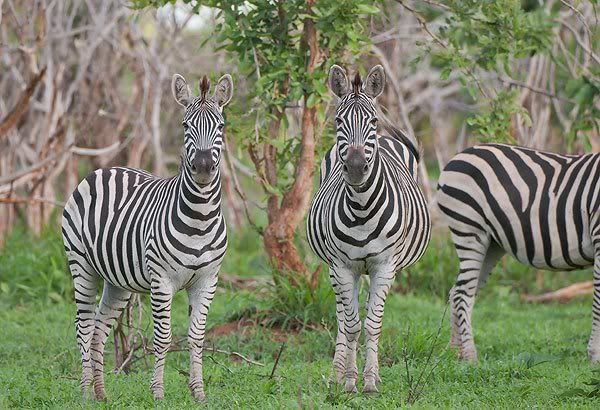
Inquisitive Zebras:


Our last dinner under the Kruger stars was nice but also sad. It's always sad to be leaving the bush and going back to the rat-race. The next morning I decided to do something bold - with the gates opening at 04h30 already, I decided to drive south as far as we can get before the gates close at 18h00, and only then take the 4 hour drive home. Talk about maximising your time in the field, haha.

These are the sightings we enjoyed on this long, but rewarding drive from Punda Maria to the Paul Kruger Gate close to Skukuza.

Open-Billed Stork:


Yellow-Billed Kite:


Same raptor being harrassed by a Fork-Tailed Drongo:


The ever-present Glossy Starling (a Kruger stalwart):


Impalas locked in a fierce contest:


Cute warthog piglets:


The high level of the Olifants river this particular year:


Compare the 2 scenes I posted above with the same river, from the same viewpoint, 5 months earlier (July 2009)!


We had a long way to go still - so we carried on southwards...

Mud-bath:


Stork and Elephant:


The lovely Carmine Bee-Eater:


The lovely Lilac-Breasted Roller:


We reached the Paul Kruger gate around 5pm (and got home by about 9pm!). I am looking forward to possibly fitting in another trip to the northern reaches of the Kruger National Park in the next few months. I hope you enjoyed these trip reports...I've got a few to catch up on so there are more coming!

Have a blessed Christmas time with your families and loved ones!!
God bless you all.

Morkel Erasmus

Thursday, 19 December 2013

Kruger: December 2009 (Part 8)

The next morning we headed off (read the previous episode HERE) early northwards, as our next stop was at the Punda Maria rest camp for the night. The plan was to drive up to Pafuri and enjoy the scenery there, before heading to the camp as our book-in time was only later in the day.

This was the sunrise that greeted us over the Shingwedzi river that morning.


The family of Ground Hornbills was there to see us off...

 
Close to the Babalala Picnic Spot I had some good photographic moments with this European Roller.


We pushed northwards, and I always love driving past this clump of trees on this road.


A herd of Cape Buffalo was grazing in the thickets, but this guy gave me a quick silly pose before we drove off.


There's always a good chance to spot some Tsessebe antelope in the northern reaches of Kruger, and this time we found a herd crossing the road in front of us. They do look a lot like East Africa's "Topi" and are related to them (part of the Hartebeest genus).


On the road up to Pafuri we came across a Yellow-billed Kite hunting/hovering right above our vehicle and the road.


We found a lovely herd of Nyala on the appropriately named "Nyala Loop". They are such graceful antelopes.


It was still very gloomy when we turned into the Pafuri main loop...


This remains one of the most beautiful spots in Southern Africa in my estimation. Seeing some wildlife wander through here is an added bonus.


We spotted a Woodlands Kingfisher who was catching food to feed his mate.


The local residents of the Levuvhu River were presiding as well...a large pod of Hippopotamus and some nasty-looking Nice Crocodiles were spotted.


We made it all the way to Crook's Corner - where the countries of Zimbabwe, South Africa and Mozambique meet at the confluence of the Levuvhu and Limpopo rivers.

The spot derives its name from days gone by when the islands in the middle of the river were safe zones and no-man's land where wanted criminals could hide out from the law enforcement agencies of any of these 3 countries.


We slowly made our way towards Punda Maria to go and check into our chalet. We would only be spending one night there, and tomorrow would be our last day in the Park.

On the way to camp we came across a Hamerkop hunting in a shallow pool.


Stay tuned for the next and final episode which should be posted over the weekend!

Morkel Erasmus