Showing posts with label cute. Show all posts

Saturday, 28 May 2016

Delight at the Dog Den

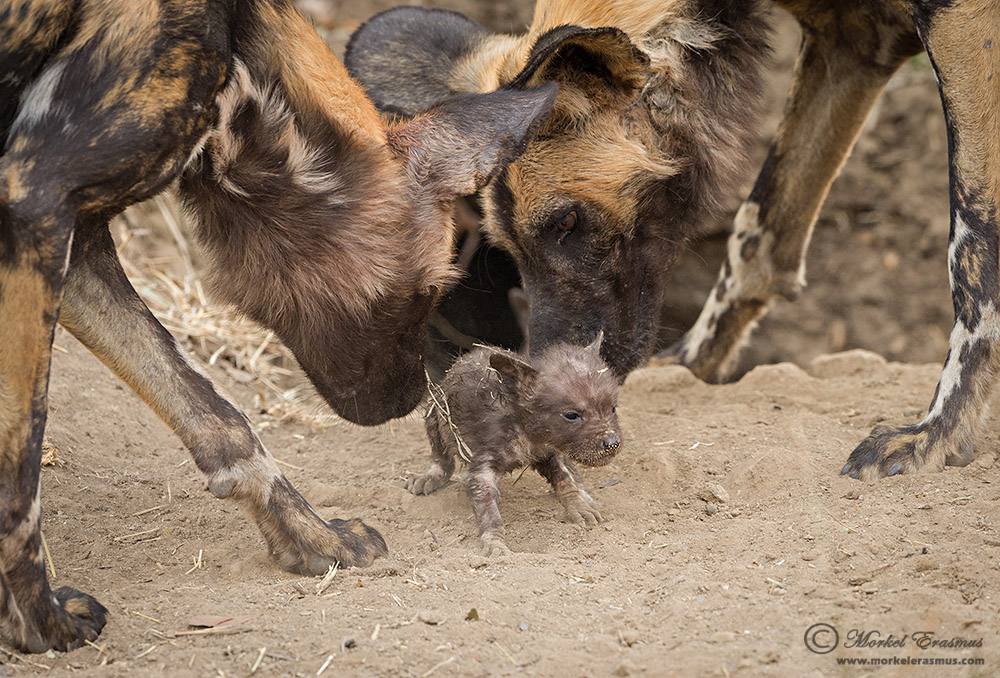
Last year, my wife and I had an incredible privilege: we witnessed the moment a massive litter of 17 highly endangered African Wild Dog (Painted Dog) puppies came out of their den for the very first time.

We were in the Lowveld on a family holiday, and got the chance to head out with Grant Beverley for the day. Grant heads up the EWT (Endangered Wildlife Trust) Wild Dog research and monitoring for the Greater Kruger area of South Africa. We visited two separate packs of the enigmatic "painted wolf". The first one was situated in the Zandspruit Aero Estate, in the town of Hoedspruit. To see these animals adapting and denning with puppies in a residential eco-estate where people were developing holiday homes was quite something!

We only caught fleeting glimpses of the alpha female of this pack, and decided to head out to the Ngala Private Game Reserve bordering the Orpen gate of the Kruger National Park.

Last year, the alpha female of this pack gave birth to a whopping 17 puppies! They had, at that point, never ventured out of the den. Grant was hoping that the pack would possibly call them out for the first time (he visited this den nearly every day, was in contact with the Ngala guides, and had camera traps installed at all his monitored den sites).

(note: all images shot in this post were captured with a Nikon D3s and Nikkor 500mm f4 VR lens)


When we arrived, the pack adults were lazing about, and I was able to capture some portraits of them. It was evident that they had recently made a kill, as their faces were covered in fresh blood.


It looked like we were in for a long wait that would possibly not result in any visual of the pups. Suddenly, one of the adults moved towards the den (seemingly an abandoned warthog burrow).


More of the adults moved towards the den entrance, with some starting to vocalise with yelps and chirps...and then two little faces appeared from the abyss!


Followed by a couple more!


What followed was just one of the most special moments I've ever witnessed in the bush - the pack proceeded to regurgitate some of their meat of the day's kill for the youngsters. It might seem gross to some people, but this is a piece of behaviour few people have had the privilege to witness as intimately as we were doing at that moment...


Here's a short video clip of what we saw!


We also sat and watched as the pups explored around their den for the first time, how some of the adults haphazardly handled the roughed up the runts of the litter, and how they all eventually were signaled by the alpha female that it was time to get back to the safety of the den.


I hope that you are not bored by now with these images!

Before it was all over, I did get a chance to capture the pups all lined up at the den entrance for one last glance at the weird people in the Land Rover with the pointy thing that keeps clicking...


It is very rare for a single female to have this many puppies. They survived much longer than anyone could have dreamed, as the pack cared well for them and protected them. In the meantime, the pack has split and regrouped with other dogs many times, so it's hard to determine exactly how many of the 17 pups have seen their first "birthday".

The work that Grant and the EWT are doing is immensely important in ensuring the viability and genetic diversity of the South African population of this rare predator. Their territories are vast, and as human encroachment keeps fragmenting the amount of land under dedicated conservation, the pressure on them will mount. Your donations can keep this team focused on monitoring and managing the greater Kruger meta-population with long-term survival and sustainability in mind. Please consider making a donation!

Thank you for viewing and reading!

Morkel Erasmus

Tuesday, 27 May 2014

Sharpe's Grysbok

I thought it apt to share something graceful and beautiful with you, in light of my recent posts...

This is a cute little antelope found in Southern Africa called the Sharpe's Grysbok (Raphicerus sharpei). The name "Grysbok" translates directly from Afrikaans as "grey buck", and though they're not primarily grey of colour you can see the grey stubble coming through in its coat, as if it's sporting the beard of a middle-aged man.

This is a very elusive, timid and shy little creature, and getting it to pose nicely for a photo is a rare treat indeed. They are solitary animals, but I have been fortunate to see a mating pair once, "doing their thing". This photo was captured close to Punda Maria rest camp in the Kruger National Park (South Africa). He was being a good model next to the road for me.

Techs:
Nikon D3s
Nikkor 500mm f4 VR-II
f5.6  |  1/2000 SS  |  ISO-640


click on the photo to view at proper resolution and sharpness

I hope you all have a fabulous day. Thanks for viewing!

Morkel Erasmus

Tuesday, 15 April 2014

Foxtrot Fun

The Cape Fox (Vulpes chama) is the only true fox genus in Southern Africa. They are nocturnal animals for the most part, but in places like the Kgalagadi Transfrontier Park you often get to see them early in the morning or at dusk. Towards the end of the year they start denning, and this is when photographing them can be at its most productive: the kits are playful and boisterous, eager and curious to learn more about the big world they suddenly find themselves in. This creates some problems for their mothers who are tasked to raise them alone...protection and vigilance.

This photo shows two remaining kits of a litter of 3 playing in the cool of an overcast morning in the Nossob riverbed, with mom dutifully keeping an eye out for danger in the background. Cape Fox kits have high mortality rates, as there are many predators, raptors and snakes eager for a quick morsel.

Techs:
Nikon D3s
Nikkor 500mm f4 VR-II
1.4x teleconverter
f7.1  |  1/640 SS  |  ISO-800


click on the photo to view at optimal sharpness and resolution

I hope you have a wonderful day!

Morkel Erasmus

Thursday, 20 March 2014

Rowdy Family

Who doesn't love a cute picture of primates? Chacma Baboons nearly always provide for some adorable, funny and interesting moments to be captured on camera, and this was certainly the case recently on the Chobe river. We were able to drift very close with the Wild Eye photographic boat when we were photographing a number of baboon troops along the banks of the river, especially in the early mornings.

This frame really needs no explanation - it was a special moment and my guests and I were able to isolate these four from the rest of the troop using correct framing/composition. Can you think of an apt caption for this? What would the "parents" be thinking? Leave a comment if you have a quirky one...

Techs:
Nikon D800
Nikkor 500mm f4 VR-II
f4.0  |  1/200 SS  |  ISO-3200

click on the photo to display at optimal resolution and sharpness

Morkel Erasmus

Tuesday, 15 October 2013

Kalahari Kinky

Wildlife behaviour is a treat to observe and photograph. Yes, there are many many mundane moments where you just have to sit and wait it out. Take sleeping lions, for example...boring...until they suddenly get up and stalk something that ambles by. If you really want to capture some interesting - almost anthropomorphic behaviour - you need to pay attention to the smaller critters of the bush. The primates and the squirrels are good examples.

This photo shows a trio of Ground Squirrels in the Kalahari desert (Kgalagadi Transfrontier Park) engaged in mutual social grooming...at least that's what the textbook tells us is happening...but what's the first thing that comes to mind when you see this frame? LOL

Techs:
Nikon D3s
Nikkor 500mm f4 VR-II
f8.0  |  1/1000 SS  |  ISO-450

click on the photo to display properly

Until next time...keep - uhm - grooming!

Morkel Erasmus

Monday, 14 October 2013

Foxy Face

Southern Africa has a couple of interesting canids to see when you are on safari. Besides plenty of Black-backed Jackals, the rare Side-striped Jackal and the funky-looking Bat-Eared Fox...there's also the Cape Fox (Vulpes Chama). This is our only true fox species, and they are beautiful and great fun to photograph.

Later this year I will be headed back to one of my favourite parks with my family - the Kgalagadi Transfrontier Park in the Kalahari desert. We will be going right in time to hopefully see many dens of Cape Foxes with the young ones playing about energetically. This particular kit was sitting in a slight drizzle right outside its den, and also right beside the road. I used my telephoto lens and went in for a tight portrait.

Techs:
Nikon D3s
Nikkor 500mm f4 VR-II
1.4x teleconverter
f5.6  |  1/500 SS  |  ISO-1000
Exposure Bias +0.7 

click on the photo to display properly

I hope you enjoyed this one. Have a great week, friends!

Morkel Erasmus

Tuesday, 17 September 2013

The Poser

You'll notice I'm posting more photos locally on my blog...I'm moving more of the stories I share on my Facebook Page here so that traffic to my blog can be increased, and that I have my stuff hosted on my blog rather than a Facebook Page that can be taken away if the powers that be so choose.

This is a baby Chacma Baboon photographed in the Kruger National Park in South Africa. These little guys are photographic gems and always provide fun, interaction and quirky poses like this. This guy was part of a troop which hangs around the Shingwedzi river close to Shingwedzi rest camp. Their whole area has changed due to the recent floods there, so I'm not sure if the troop has moved on. 

Overcast, rainy weather evened out the shadows and created a nice exposure with soft light. You always need to be mindful for great poses with primates, especially ones which can seem anthropomorphic. The smaller the subject, the more important the shooting angle also becomes. I was able to get a decent low perspective here, even though I was shooting from my vehicle parked on the road. 

Techs:
Canon 1000D
Canon 100-400mm L IS USM
f6.3  |  1/500 SS  |  ISO-800
Exposure Bias +0.3 

This photo is Copyrighted © Morkel Erasmus Photography.

You may share this image as presented here under the Creative Commons Attribution-NonCommercial-NoDerivs 3.0 licence (CC BY-NC-ND 3.0).


NBClick on the photo to display correctly


Morkel Erasmus

Tuesday, 30 November 2010

PhotoShare: Hold On!!

It seems the weeks are getting more hectic as the year drags to an end!


Here is a shot I took in December 2009 (almost a year ago) in the northern region of the Greater Kruger Transfrontier Park.


This little chacma baboon was clinging to his mother for all he was worth as she strolled on by early one morning close to the Shingwedzi river. I love framing portraits of animals that sort of break the mold, and this is an example of one. Many people will find many things wrong with this picture in terms of composition and the likes (for example, the mother's feet are too close to the picture's edge)...but somehow this just works for me. This photo is only cropped slightly from the left-hand side and converted to black-and-white to enhance the story.


Would love your thoughts??


f4.0  //  1/200 SS  //  ISO-800


Enjoy the rest of the week!


Morkel Erasmus